Tutte le esperienze prenotabili in Italia, in un unico posto — confrontate tra GetYourGuide, Headout e Viator, ordinate per recensioni, prenotate sul loro sito al loro prezzo.
© 2026 LivingLocal. Tutti i diritti riservati.
Usiamo solo i cookie necessari al sito. Le analitiche (Google, PostHog) solo se acconsenti.
Da
≈105 € — Prezzo indicativo. Il fornitore lo applica in USD; conversione a un tasso di riferimento. L'importo esatto è mostrato al momento della prenotazione.a personaFor a full refund, cancel at least 24 hours before the scheduled departure time.
Non incluso
piazza della minerva
15minPiazza della Minerva is a historic square in Rome’s Pigna district, situated just southeast of the Pantheon over the ancient ruins of a temple complex dedicated to Minerva. Its focal point is Bernini’s Pulcino della Minerva, a famous Baroque monument featuring a 6th-century BC Egyptian obelisk resting atop a marble elephant pedestal. The square is dominated by the Basilica of Santa Maria sopra Minerva, renowned as Rome’s primary surviving Gothic interior despite its sober Renaissance facade by Carlo Maderno. Framing the rest of the piazza are elegant 16th- to 18th-century institutional palaces, including the Palazzo della Minerva and Palazzo Severoli.
santa maria sopra minerva

Valutazione 5,0(2878), 2878 recensioni·Tour della città·Durata 3 h

Valutazione 4,9(2042), 2042 recensioni·Tour della città·Durata 3 h
Offerta specialeValutazione 5,0(5191), 5191 recensioni·Tour della città·Durata 2 h – 7 h

Valutazione 5,0(2817), 2817 recensioni·Tour della città·Durata 3 h

Valutazione 5,0(1858), 1858 recensioni·Tour della città·Durata 3 h

Valutazione 4,9(1513), 1513 recensioni·Tour della città·Durata 2 h 30 min
Offerta specialeValutazione 4,9(939), 939 recensioni·Tour della città·Durata 3 h

Valutazione 5,0(1085), 1085 recensioni·Tour della città·Durata 4 h
Salta la filaValutazione 4,5(6410), 6410 recensioni·Parco a tema

Valutazione 4,9(4243), 4243 recensioni·Tour della città
Offerta specialeValutazione 4,7(2763), 2763 recensioni·Parco a tema·Durata 7 h

Valutazione 4,9(2172), 2172 recensioni·Tour della città·Durata 2 h
Viator
The Basilica of Santa Maria sopra Minerva is notable as Rome’s principal surviving example of medieval Gothic interior architecture. Built by Dominican friars starting in the late 13th century over ancient Roman temple remains, its plan features a traditional three-nave layout supported by clustered piers. Inside, dramatic rib-vaulted ceilings painted deep blue with gold stars contrast sharply with the plain, flat Renaissance facade added to the exterior. Over the centuries, the original Gothic framework was enriched with Renaissance and Baroque side chapels, housing masterworks by artists such as Michelangelo and Bernini.
pantheon
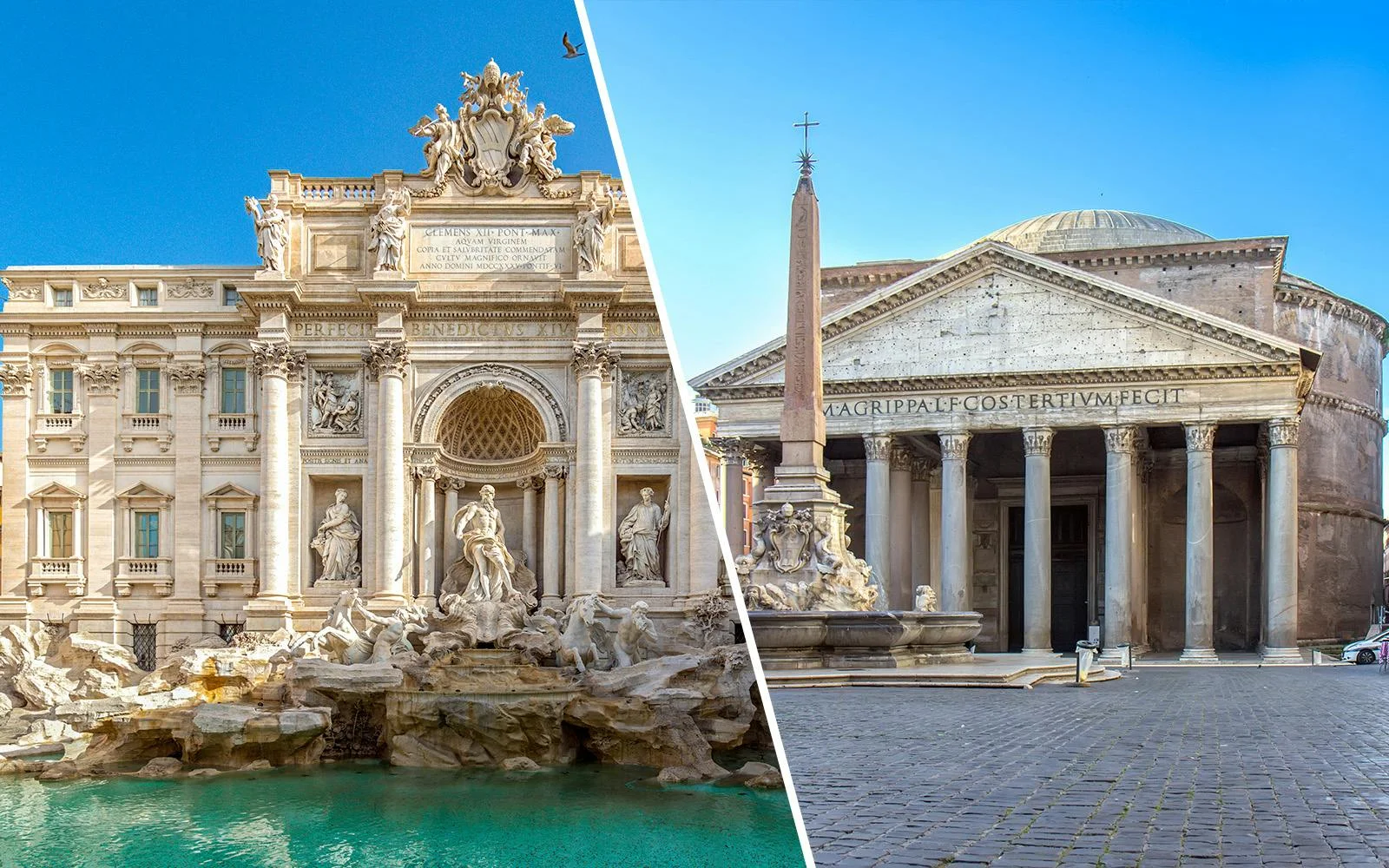
15minThe Pantheon is an iconic Ancient Roman temple, rebuilt by Emperor Hadrian around 126 AD, that seamlessly fuses classical Greek and innovative Roman engineering. Its exterior features a monumental portico with massive granite Corinthian columns that opens into a magnificent circular concrete rotunda. Inside, the building’s height and interior diameter are exactly equal at 43.3 meters (142 feet), creating a perfect sphere of space under the world's largest unreinforced concrete dome. At the dome's apex sits an open 9-meter oculus, which serves as the sole source of natural light and connects the interior directly to the sky above.
Piazza Navona
15minPiazza Navona is a masterpiece of Roman Baroque urban design, built directly over the open space of the 1st-century AD Stadium of Domitian and retaining its distinctive elongated, U-shaped arena footprint. The western flank is dominated by Francesco Borromini’s church of Sant'Agnese in Agone, featuring a dramatic concave facade flanked by twin bell towers and topped by an imposing dome. At the center of the square stands Gian Lorenzo Bernini’s monumental Fontana dei Quattro Fiumi (Fountain of the Four Rivers), anchored by a towering Roman-era Egyptian obelisk. The square is harmoniously framed by 17th-century palaces, including the massive Palazzo Pamphilj, creating a theatrical urban ensemble that epitomizes Papal Baroque architecture.
tempio di adriano
15minThe Temple of Hadrian (Tempio di Adriano) in Piazza di Pietra is a striking 2nd-century AD Roman monument dedicated to the deified Emperor Hadrian by his successor Antoninus Pius. Originally a classic octastyle peripteral temple set on a high peperino tufa podium, its most prominent surviving feature is a row of eleven massive fluted Proconnesian marble columns of the Corinthian order. In the late 17th century, architect Carlo Fontana dramatically incorporated the ancient colonnade and cella wall directly into the facade of the papal customs house (Dogana di Terra), now the Rome Stock Exchange (Palazzo della Borsa). Inside, preserved fragments of the original barrel-vaulted cella with coffered stuccoes stand in contrast to the surrounding Baroque and neoclassical additions.
colonna di marco aurelio
15minThe Column of Marcus Aurelius in Piazza Colonna is a monumental 2nd-century AD Roman victory column modeled after its predecessor, Trajan’s Column. Standing nearly 30 meters (100 feet) tall, the hollow Carrara marble shaft is composed of 28 massive cylindrical drums and features an internal spiral staircase leading to a top platform. Its exterior is encased in a continuous spiral relief depicting the Danubian Marcomannic Wars, carved in a expressive, high-relief style that emphasizes dramatic depth and emotional intensity over strict classical proportions. In 1589, Pope Sixtus V commissioned Domenico Fontana to restore the monument, which included replacing the original base and capping the summit with a bronze statue of Saint Paul.
Scalinata di Trinità dei Monti
15minThe Column of the Immaculate Conception (Colonna dell'Immacolata Concezione), located in Piazza Mignanelli adjacent to the Spanish Steps, is a 19th-century Marian monument designed by architect Luigi Poletti. At its core is an authentic ancient Roman Corinthian shaft of cipollino marble—discovered in 1777 during local excavations—that rises nearly 12 meters atop an elaborate marble pedestal. The square base features bronze bas-reliefs illustrating key biblical events and is flanked at the corners by four larger-than-life marble statues of Old Testament figures, including Moses and David. Crowning the entire structure is a bronze statue of the Virgin Mary sculpted by Giuseppe Obici, depicting her standing on a globe and crescent moon while stomping a serpent.
colonna dell'immacolata - piazza di spagna
15minThe Column of the Immaculate Conception (Colonna dell'Immacolata Concezione), designed by architect Luigi Poletti and dedicated in 1857, stands in Piazza Mignanelli near the Spanish Steps. Its central shaft is an authentic ancient Roman Corinthian column of fluted cipollino marble—excavated in 1777—that reaches a height of nearly 12 meters. The monument's massive square base is decorated with bronze bas-reliefs depicting scenes of the Annunciation and dogma decree, anchored at the corners by four seated marble statues of Old Testament prophets. Crowning the ancient capital is a bronze sculpture of the Virgin Mary created by Giuseppe Obici, depicting her standing atop a celestial sphere and crescent moon.
Fontana di Trevi
15minThe Trevi Fountain (Fontana di Trevi), designed by Nicola Salvi and completed in 1762, is a monumental late-Baroque masterpiece seamlessly integrated into the central facade of the Palazzo Poli. Organized around the classical motif of a central triumphal arch, the architecture is defined by giant engaged Corinthian columns and pilasters that frame a vast central niche housing the statue of Oceanus. Above these giant order columns, a tall attic story decorated with allegorical statues and crowned by the papal crest caps the monumental facade. Below the classical structure, rugged travertine rock formations and cascades spill outward into a broad basin, blending formal architecture with dynamic natural water features.
Altare della Patria
15minThe upper terrace of the Altare della Patria (Vittoriano), designed by Giuseppe Sacconi, is defined by a majestic curved colonnade (portico) executed in brilliant white Botticino marble. The screen features sixteen 15-meter-tall fluted columns of the Corinthian order, arranged in a subtle concave arc that forms an elevated backdrop overlooking Piazza Venezia. Each column is crowned by a detailed Corinthian capital supporting an elaborate entablature, where statues above the cornice represent the sixteen historical regions of Italy. Flanked at either end by raised classical propylaea topped with bronze quadrigae, this monumental colonnade draws inspiration from ancient Hellenistic sanctuaries to create a theatrical crowning element for the national monument.
Piazza del Campidoglio
15minPiazza del Campidoglio, designed by Michelangelo in 1536 atop the Capitoline Hill, is a triumph of Renaissance urban planning that transformed Rome's civic center to face St. Peter's Basilica rather than the ancient Forum. To correct the awkward angle between the existing Palazzo dei Senatori and Palazzo dei Conservatori, Michelangelo introduced a trapezoidal layout anchored by a third matching structure, the Palazzo Nuovo, creating an intentional sense of perspective. At the heart of the square stands a replica of the ancient bronze equestrian statue of Marcus Aurelius, centered within an intricate geometric twelve-pointed star embedded inside an oval paved plaza. The monumental ensemble is approached via the Cordonata, a wide, grandly sloped staircase flanked by colossal ancient statues of Castor and Pollux at its summit.
teatro di marcello
15minThe Theatre of Marcellus (Teatro di Marcello) is a historic open-air theater commissioned by Julius Caesar and completed by Emperor Augustus in 13 BC, serving as a primary structural prototype for the Colosseum. Its surviving exterior curved facade is built of travertine and originally featured three tiered arcades showcasing superposed classical orders—Doric on the ground level and Ionic on the second tier. During the 16th century, architect Baldassarre Peruzzi transformed the ruined upper structure by capping the ancient arcades with a upper Renaissance palace level for the Savelli family (later owned by the Orsini). Today, the building presents a unique architectural palimpsest where ancient Roman open-arched arcades directly support a lived-in Renaissance urban residence.