- 1
These waters tell the story of the land, the sea, and the timeless charm of Sorrento. The tour departs from the harbor and follows the stunning Sorrento Coast, cruising along one of the most scenic stretches in Italy.
During the navigation, guests admire dramatic cliffs, hidden sea caves, and picturesque coastal views from a unique perspective. Several panoramic points are highlighted along the route, with time to take photos and enjoy the landscape in complete relaxation.
A professional crew is always on board and the boat is fully equipped with safety gear, including life jackets available for all guests.
- 2
Marina Grande - Antico Borgo Marinaro
Pass byBelow the cliffs lies Marina Grande, one of Sorrento’s most authentic and ancient corners. More than a harbour, it is a village within the town, where life still follows the rhythm of the sea—fishermen’s boats in bright colours, the scent of salt in the air, and traditions that have endured for centuries.
With origins dating back to Greek and Roman times, the small bay is naturally sheltered by Sorrento’s western headland, offering a safe haven from winds and storms. Along the beach, boats are often pulled ashore like strokes of colour against sea and stone, while the quiet work of repairing nets recalls a maritime culture that has never faded.
Above the shore stands an old gate, once closed at night when Sorrento was fortified. At the heart of the community, the Church of Sant’Anna is celebrated each summer with lights, processions, and fireworks reflected on the water. Seen from the sea, Marina Grande reveals its truest face: modest, lively, and timeless.
- 3
Bagni Regina Giovanna
Pass byThe Baths of Queen Giovanna are among the most enchanting and mysterious places on the Sorrento Peninsula: a dramatic cliff that shelters a natural pool, hidden among the rocks like a treasure shaped by the sea.
The name is linked to Giovanna II of Anjou-Durazzo, the legendary fifteenth-century queen—fascinating and controversial—who, according to local tales, used to retreat here in secret under the moonlight. Legends, exaggerated over time, helped build the myth of a free, powerful, and feared woman.Yet the site is even older. On the promontory once stood a grand Roman villa from the 1st century BC, chosen for its peace and sweeping sea views. The heart of the Baths is the inner lagoon, connected to the open sea through a natural arch: when sunlight filters through, the water glows in shifting shades of emerald.
Surrounded by Mediterranean scrub and the scent of salt on the breeze, this bay still feels intimate and timeless—where history and legend blend into one unforgettable scene.
- 4
The bay in view is the Bay of Puolo, where nature, history, and maritime traditions have lived side by side for centuries. Calm waters, a small beach, and fishermen’s houses reveal a more authentic Sorrento—simple, genuine, and timeless.
Puolo was also once home to an important tuff quarry. Stone extracted here was used to build many homes and structures across the Sorrento Peninsula. Even today, the cliff shows smooth, regular surfaces: visible traces left by the quarrying activity that helped shape this landscape.
Along the promontory, an elegant residence rises above the sea: the former villa of Achille Lauro, the renowned Neapolitan shipowner whose fleet employed hundreds of Sorrentine sailors and helped bring this coastline to major Mediterranean ports. His name is also linked to the passenger ship Achille Lauro, involved in the 1985 terrorist hijacking.
Today, the clear sea and Mediterranean vegetation restore a peaceful atmosphere—where memory, labour, and beauty still coexist.
- 5
The coastline in view belongs to Massa Lubrense, where the mountains seem to plunge straight into the sea, linking the Sorrento Peninsula to the Amalfi Coast—two worlds united by the same rock, citrus scent, and golden light.
This land is also known as the birthplace of limoncello: among ancient terraces and rows of “femminello” and “ovale sorrentino” lemons, the simple recipe took shape—fragrant peels, pure alcohol, water, and sugar—first as a family tradition, long before becoming an icon.
Along the shore, ancient Saracen towers still stand, built from the Middle Ages through the Spanish period to defend against pirate raids. They once signaled danger with smoke by day and fires by night, like silent sentinels over the coast.
Further ahead lies the Scoglio del Vervece, a beloved symbol for sailors and divers. Tradition says a Madonna statue rests on the seabed to protect those at sea; every September, boats gather here in silence as divers lay flowers underwater.
- 6
The Scoglio del Vervece is a small, dark rock rising from the sea off Massa Lubrense, a quiet landmark with deep meaning for sailors and divers. From a distance it looks like a simple outcrop, but locally it is seen as a symbolic “guardian” of these waters.
Tradition says a statue of the Madonna rests on the seabed here, placed to protect fishermen, seafarers, and anyone navigating the coast. Beyond its religious value, it reflects an ancient maritime instinct: entrusting the sea with a benevolent presence where it can also be unpredictable.
Every September, boats gather around the rock in respectful silence while divers descend to lay flowers underwater near the statue, in memory of those lost at sea. Beneath the surface, the rock continues into a lively underwater landscape, making Vervece one of the area’s most loved dive sites.
- 7
The coastline in view belongs to Meta di Sorrento, one of the gateways to the peninsula. Here, tuff cliffs rise in dramatic vertical walls, shaped by the sea and by ancient volcanic forces over thousands of years. Their warm tones—yellow to reddish—tell a story written by time itself.
Meta is also famous for its wide beaches, among the largest on the peninsula. The shoreline opens into broad stretches of golden sand, once used as landing points for fishermen and farmers transporting wine, lemons, and local goods between small marinas.
Above, slender houses stand along the cliff’s edge, seemingly suspended between sky and sea. Deeply linked to navigation and boatbuilding, Meta has long been home to skilled sailors and master craftsmen, with hidden inlets and sea-carved caves completing this enchanting stretch.
- 8
The coastline in view lies in front of Piano di Sorrento, where tuff cliffs rise in dramatic vertical walls shaped by the sea and ancient volcanic forces. This area has a strong maritime heritage: generations of captains and sailors departed from these shores, and local families still remember long voyages and emotional returns.
Ahead is the Lido di Cassano, today a popular beach but once an important landing point for fishermen, merchants, and farmers moving wine, lemons, and local goods along the coast—rock-carved stairways and terraces still recall that past.
Westward, the peaceful Gulf of Pecoriello opens as a small, quiet inlet among gardens and lemon groves. Nearby stands Villa Nicolini, surrounded by the legend of a “curse of the cliff,” and further on rises the historic Cocumella Hotel, once a 17th-century Jesuit convent, famous for its panoramic gardens above the sea.

 Special offer
 Special offer
 Skip the line
 Special offer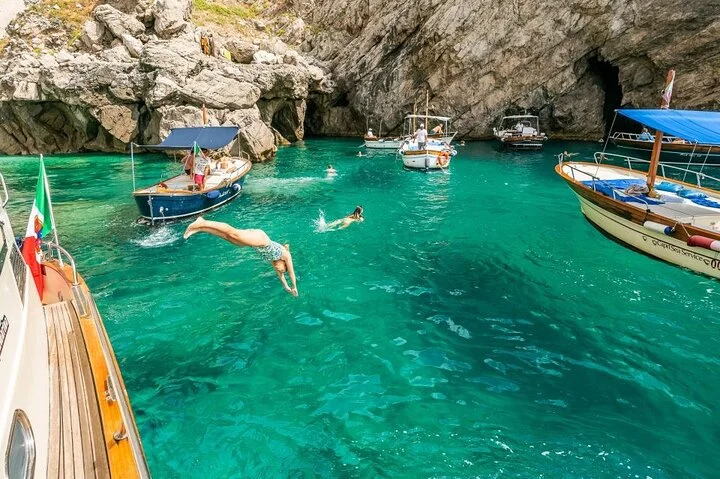
 Special offer


