Every bookable experience in Italy, in one place — compared across GetYourGuide, Headout and Viator, ranked on reviews, booked on their site at their price.
© 2026 LivingLocal. All rights reserved.
We use only the cookies this site needs to work. Analytics (Google, PostHog) load only if you agree.
From
$188per personFor a full refund, cancel at least 24 hours before the scheduled departure time.
Good for

Rating 4.9(767), 767 reviews·City tour·Duration 3 h

Rating 5.0(466), 466 reviews·City tour·Duration 3 h

Rating 5.0(728), 728 reviews·City tour·Duration 4 h

Rating 5.0(1,836), 1,836 reviews·City tour·Duration 3 h

Rating 4.9(433), 433 reviews·City tour·Duration 2 h 30 min

Rating 5.0(193), 193 reviews·City tour·Duration 3 h

Rating 4.9(775), 775 reviews·City tour·Duration 3 h

Rating 5.0(2,722), 2,722 reviews·City tour·Duration 3 h

Rating 5.0(414), 414 reviews·City tour·Duration 2 h – 2 h 30 min

Rating 4.9(225), 225 reviews·City tour·Duration 1 h 35 min

Rating 4.9(165), 165 reviews·City tour·Duration 2 h

Rating 5.0(133), 133 reviews·City tour·Duration 30 min – 1 h 40 min
Viator
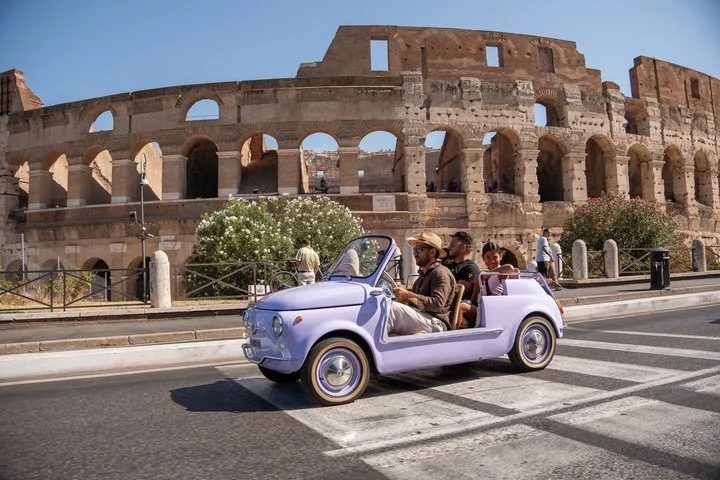
Explore Rome in a unique and luxurious way aboard a private convertible. Discover hidden treasures and iconic places of the Eternal City with style and exclusivity. Savor two local delicacies for an authentic Italian gastronomic experience as you immerse yourself in Roman flavors and sights.
Not included
Porta Pia
Pass byPorta Pia is a historic monumental gate located in Rome, built in 1561 to a design by Michelangelo. It is located along the Aurelian Walls and is famous for being the scene of the entrance of the Italian army to Rome in 1870, an event that marked the end of the Papal States and the annexation of the city to the Kingdom of Italy. The gate is an important symbol of the modern history of Rome.
Stop 2
Pass byThe Aurelian Walls are an imposing fortification built in Rome between 271 and 275 AD.C. under Emperor Aurelian, to defend the city from barbarian invasions. These walls, about 19 kilometers long, enclose an area that included ancient Rome and some peripheral areas. The Aurelian Walls are among the best preserved Roman fortifications and today, in part, are visible in different points of the city, representing an important testimony of imperial Rome.
Villa Borghese
Pass byVilla Borghese is one of the most beautiful and important parks in Rome, located in the heart of the city. It covers about 80 hectares and offers a wide variety of gardens, ponds and paths. Inside there are numerous historic buildings, including the Borghese Gallery, which houses a large collection of works of art by artists such as Caravaggio, Bernini and Raphael. Villa Borghese is an ideal place for walks, relaxation and culture, and is one of the main green landmarks of the capital.
Via Veneto
Pass byVia Veneto is one of the most famous and elegant streets in Rome, located in the Ludovisi district. Known for its history linked to cinema and the dolce vita of the 1950s and 1960s, Via Veneto is home to numerous luxury hotels, historic cafes and trendy clubs. During the "Dolce Vita" period, it was frequented by celebrities, intellectuals and journalists. Today, it is still one of the main arteries of the city, famous for its sophisticated atmosphere and for being close to emblematic places such as Villa Borghese and the Trevi Fountain.
Fontana dell'acqua Felice
Pass byThe Happy Aqueduct Fountain is one of the historic fountains of Rome, located in Piazza di San Bernardo, near Termini Station. It was built in 1587 on commission of Pope Sixtus V to celebrate the restoration and expansion of the Felice Aqueduct, which brought drinking water to the city of Rome. The fountain was designed by the architect Giacomo della Porta and has a large triumphal arch, with a central basin. Water flowed from the shoulders of a female figure, symbolizing the "fortune" of the Happy Aqueduct. It is one of the most significant fountains of the Roman Renaissance, a symbol of hydraulic engineering and the greatness of the papacy of Sixtus V.
Basilica di Santa Maria degli Angeli e dei Martiri
Pass byThe Basilica of Santa Maria degli Angeli e dei Martiri is located in Piazza della Repubblica and was built in 1561 to a design by Michelangelo Buonarroti inside the Baths of Diocletian. The church is famous for its grandiose Renaissance architecture, the use of Roman ruins and the sundial designed by Giovanni Domenico Cassini.
Stop 7
Pass byThe Baths of Diocletian are one of the largest and most majestic thermal buildings in ancient Rome, built between 298 and 306 AD.C. by Emperor Diocletian. They occupied a large area in the Viminale district and could accommodate up to 3,000 people. In addition to the traditional spa rooms, they also included gyms, libraries and gardens. Today, part of the baths houses the National Roman Museum, while another section is used by the Basilica of Santa Maria degli Angeli. The ruins of the baths are still an important testimony of Roman engineering.
Santa Maria Maggiore
Pass byThe Basilica of Santa Maria Maggiore is one of the four papal basilicas in Rome and one of the most important churches in the city. It is located on Piazza di Santa Maria Maggiore and is dedicated to the Virgin Mary. It was built in the 5th century, during the pontificate of Pope Sixtus III, and is famous for its architectural splendor, combining elements of the Late Antiquity and Baroque. The church is famous for its mosaics, especially those of the fifth century that decorate the apse, and for the majestic Sistine Chapel, which houses the relics of the Madonna della Neve.
Colosseum
Pass byThe Colosseum is one of the most iconic monuments in Rome and one of the Seven Wonders of the World. Built between 70 and 80 AD.C. under the emperors Vespasian and Titus, is a Roman amphitheater that could accommodate up to 50,000 spectators. It was used for gladiator fights, public performances and other events. The Colosseum, symbol of the greatness of the Roman Empire, is still an important tourist attraction and an emblem of the history and culture of Rome.
Palatine Hill
Pass byThe Palatine Hill is one of the seven hills of Rome and an archaeological site of great historical importance. It is famous for being the original heart of the city, where according to legend, Romulus founded Rome in 753 BC.C. On the Palatine Hill are the remains of ancient imperial residences, such as the Palace of Domitian and the House of Livia, as well as the Circus Maximus, used for chariot races. The hill also offers a panoramic view of the city and is one of the most impressive places to understand the history and development of ancient Rome.
Circo Massimo
Pass byCircus Maximus is an ancient Roman stadium located between the Palatine Hill and the Aventine Hill. Built in the 6th century BC.C., was the largest and most important racecourse in ancient Rome, able to accommodate up to 250,000 spectators. Mainly used for chariot racing, the Circus Maximus also hosted other public events, such as games and competitions. Today, although the structure is largely in ruins, the site remains a symbol of the grandeur of Roman architecture and is used for cultural events and performances.
Aventine
Pass byThe Aventine is one of the seven hills of Rome, located south of the Tiber River. It is a quiet and green residential area, famous for its gardens and spectacular views of the city. The Aventine is also rich in history, with significant sites such as the Basilica of Santa Sabina, an example of early Christian architecture, and the Orange Garden, which offers panoramic views of Rome. It is also home to foreign embassies and numerous public parks.
Testaccio
Pass byTestaccio is a district of Rome located south of the historic center, known for its history, culture and lively nightlife. The district takes its name from Monte Testaccio, an artificial hill formed by thousands of Roman amphorae used to transport olive oil. Today, Testaccio is famous for its traditional restaurants, typical markets and trendy clubs. It is also an important area for contemporary culture, with museums such as the Macro Museum and a dynamic music scene.
Stop 14
15minMaritozzaro is a famous place in Rome, located in the Testaccio district, specialized in the preparation of maritozzo, a traditional Roman dessert. The maritozzo is a soft sandwich, generally stuffed with whipped cream, which is an icon of Roman pastry, especially during breakfast. Maritozzaro is known for the quality of its Maritozzi, made with fresh and artisan ingredients, and has become a reference point for lovers of Roman gastronomy.
Monteverde
Pass byMonteverde is a residential district of Rome, located southwest of the city center. It is known for being a quiet and green area, with numerous parks and gardens, such as the Park of Villa Doria Pamphili, one of the largest and most beautiful in Rome. Monteverde has a more relaxed atmosphere than other central areas, while being well connected to the rest of the city. The neighborhood is appreciated for its neighborhood life, with many restaurants, cafes and shops. The area also has a strong historical and cultural tradition.
Colle del Gianicolo
Pass byThe Gianicolo (Janiculum) is a hill located west of the Tiber River, near the district of Trastevere. It is one of the most beautiful viewpoints in Rome, from which you can enjoy a spectacular view of the city. The Gianicolo is of historical importance, as it was the site of crucial battles during the period of Italian Unification, particularly during the defense of the Roman Republic of 1849. Among the most famous places of the Gianicolo are the Monument to Giuseppe Garibaldi and the Fontana dell'Acqua Paola, one of the most beautiful Baroque fountains in the city.
Fontana dell'Acqua Paola
10minThe Fontana dell'Acqua Paola, located on the Gianicolo in Rome, is one of the most famous Baroque fountains in the city. It was designed by Gian Lorenzo Bernini and completed in 1612 to celebrate the restoration of the Trajan Aqueduct by Pope Paul V. The fountain is characterized by a large monumental structure, with a scenic facade overlooking Piazza Garibaldi and from which water flows. It is famous for its grandeur and the panoramic view it offers over Rome, becoming a landmark for tourists and a symbol of hydraulic engineering and Baroque art.
Via Nicolo Picccolomini
Pass byVia Niccolò Piccolomini is a street in Rome famous for a particular optical effect. It is located in the Aurelio district and, due to its location and angle with St. Peter's Basilica, offers a view in which the basilica's dome looks perfectly framed between the buildings that surround it. This visual phenomenon creates an impression of unique symmetry and perspective, with the dome appearing particularly imposing and majestic in the distance, as if it were “framed” by the street.
Stop 19
Pass byThe Villino Cirino Silveri is a historic building located in Rome, known for its architecture and its link with the history of the city. The villa is located in the Nomentano district and was designed in the early twentieth century. This building is an example of an Art Nouveau villa, which was very popular in Italy at that time. Featuring elegant architectural details, the villa represents a fusion of refined aesthetics and residential functionality.
Stop 20
10minTrapizzino prepares the best supplì in Rome, a true icon of traditional Capitoline cuisine. This tasty croquette-like snack is made with rice, mozzarella and a rich meat sauce, all breaded and fried to perfection. Legend has it that, when it breaks, the mozzarella "fili", giving rise to the famous "supplì on the phone". An explosion of flavors, perfect as an appetizer or street food for every lover of Roman cuisine.
Piramide Cestia
Pass byThe Cestia Pyramid is an ancient Roman monument located in the Ostiense district of Rome. It dates back to 12 a.C. and is one of the most famous pyramids outside Egypt. It was built as a tomb for the Roman magistrate Gaius Cestius, who wanted to be buried in a monument that recalled the Egyptian pyramids, a symbol of power and durability. The pyramid has a structure about 36 meters high and is made of brick covered with marble slabs. This monument is unique in Rome, where the Roman architectural context rarely included Egyptian-inspired elements.
Porta San Paolo
Pass byPorta San Paolo is one of the most famous and imposing gates of the Aurelian walls of Rome, located in the Ostiense district. Built in the third century AD.C. during the empire of Aurelian, the gate served as the main access to the city for those coming from the south. She is also known for her role during World War II, when she became a symbol of Roman resistance. Next to it is the Non-Catholic Cemetery and the Museum of the Walls, which tells the story of Roman fortifications. The gate is a well-preserved example of Roman military architecture.
Terme di Caracalla
Pass byThe Baths of Caracalla are one of the largest and most majestic thermal complexes in ancient Rome, located in the city center. Built between 212 and 217 AD.C. from the emperor Caracalla, the baths could accommodate up to 1,600 people and represented a place of recreation, socialization and well-being. In addition to traditional thermal baths, the complex included gyms, libraries, gardens and performance spaces. Today, the ruins of the Baths of Caracalla are one of the most visited tourist attractions in Rome, offering a fascinating testimony to Roman engineering and everyday life at the time.
Rione Monti
Pass byMonti is one of the most characteristic historical districts of Rome, located in the city center, between Termini Station and the Colosseum. It is known for its narrow streets, picturesque squares and lively atmosphere, mixing history, culture and a strong local identity. The neighborhood is full of restaurants, cafes, boutiques and craft shops, and is often less touristy than other popular areas of the capital, while maintaining authentic charm. Among the places of interest in Monti are the Basilica of Santa Maria Maggiore, the Forum of Trajan, and the Piazza della Madonna dei Monti, a meeting point for many Romans.