Every bookable experience in Italy, in one place — compared across GetYourGuide, Headout and Viator, ranked on reviews, booked on their site at their price.
Discover the magic of the Amalfi Coast and Herculaneum ruins on a private 9-hour tour. Enjoy private transportation, skip-the-line access to Herculaneum, and customizable itineraries. Explore Ravello, Maiori, and Minori, perfect for relaxed walks, beach time, and gelato stops.
Highlights
Private 9-Hour Tour
Amalfi Coast: Ravello, Maiori, Minori
Herculaneum with Skip-the-Line
What's included
In-vehicle air conditioning
Official guide in Herculaneum - If this option is selected
Live commentary on board
Skip-the-line tickets in Herculanem - IF this option is selected
Not included
Lunch
Itinerary
1
Archeological Park of Herculaneum
2h
Your private certified guide will introduce you to the History of the ancient Herculaneum. We will take care of purchasing skip-the-line tickets.
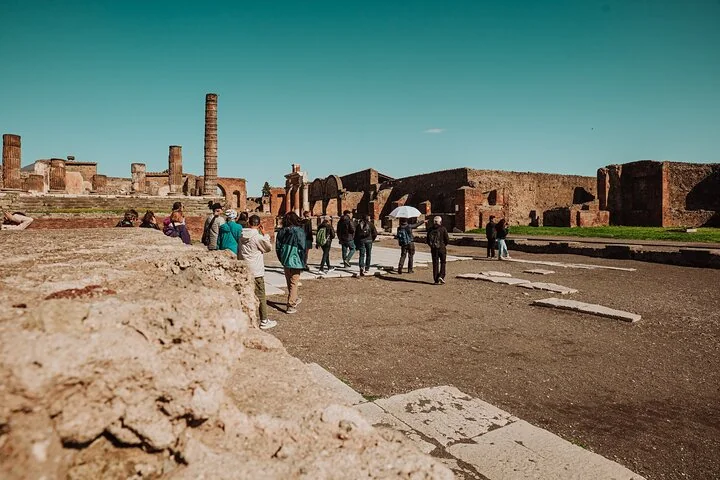
This unforgettable walking tour will make you discover the highlights of the Archaeological Park: the private homes, the bath-house, the shops, the main street, etc. Marvel at incredible frescoes and mosaics! We will see the remains of fossilized wood. We shall of course see the dramatic skeletons of the victims by the ancient marina.
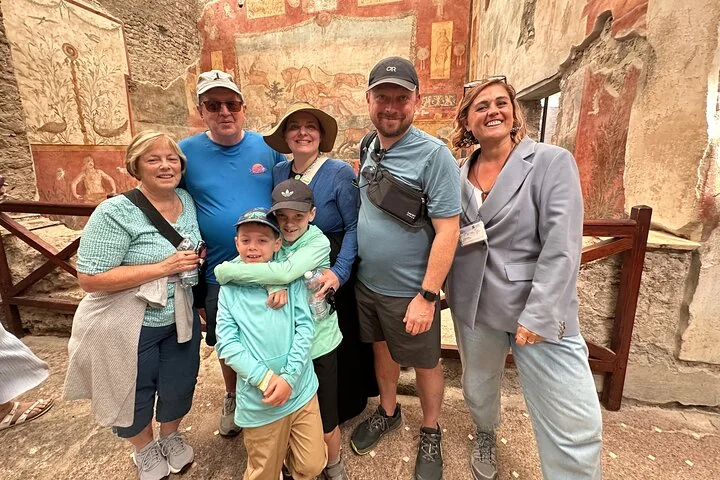
If you are traveling with kids choose the unique and entertaining family experience. This activity comes highly recommended for children between 6 and 11 years old. The “Herculaneum for kids” is led by a licensed guide properly trained to stimulate and interact with your kids with the help of a specific map, funny tools, stickers, and an activity book.
2
Parco Nazionale Del Vesuvio
Pass by
On the way to Herculaneum, people can enjoy views of the Parco Nazionale del Vesuvio, the protected landscape surrounding the volcano that shaped the region’s history. Even from a distance, the crater’s distinctive profile makes an impression—especially on younger travelers who quickly connect the mountain they’re seeing to the ancient city they’re about to explore. Once inside the archaeological site, the volcano is still dramatically visible in the background, creating a striking contrast between modern nature and the ruins below. Paired with insights from your private family guide, these views help visitors grasp the scale of the eruption and understand how deeply Vesuvius continues to define the geography and identity of the area today.
3
Antiquarium di Ercolano
Pass by
The Antiquarium offers families a thoughtful introduction to daily life in ancient Herculaneum through objects that feel surprisingly familiar—jewelry, coins, writing tools, household items, and even children’s belongings. One of the most striking features here is the survival of charred wood, from furniture to architectural fragments, preserved when the intense heat of the eruption carbonized organic materials instead of burning them to ash. Kids are often fascinated to learn that these blackened pieces are still real wood, nearly two thousand years old. With the help of your official family-friendly guide, the displays become more than just artifacts; they become clues that help young explorers piece together how Roman families lived, worked, and decorated their homes.
4
Stop 4
Pass by
The Boat Pavilion is often one of the most surprising stops for families. Inside, you’ll find a remarkably preserved Roman boat that once sailed along the Bay of Naples, along with tools and equipment used by sailors nearly 2,000 years ago. Kids are instantly drawn to the wooden hull—darkened by time but still intact—while adults appreciate how the eruption protected the vessel under layers of volcanic debris. The space also helps everyone imagine Herculaneum as a seaside community connected to trade and travel. With your dedicated family-friendly guide adding context, the exhibit becomes more than just an artifact—it becomes a story of daily life suddenly interrupted.
5
Casa dei Cervi
Pass by
At the Casa dei Cervi, your private guide brings you into one of the most elegant waterfront homes in ancient Herculaneum. As you walk through its marble floors, colonnaded garden, and rooms once decorated with fine frescoes, it’s easy to imagine the wealthy family who lived here enjoying the sea breeze and their private terrace overlooking the bay. The house takes its modern name from the striking marble statues of stags being attacked by hunting dogs, discovered in the garden and now displayed separately. With your guide explaining architectural details and social customs, the residence becomes more than just a ruin — it becomes a glimpse into the lifestyle, status, and tastes of Herculaneum’s upper class.
6
Stop 6
Pass by
At the Palestra, your private guide introduces you to the ancient equivalent of a sports and social club, where young men once trained, exercised, and gathered for events. As you walk through the large open courtyard framed by porticoes, it’s easy to picture athletes running drills, practicing wrestling, or relaxing in the shade after a workout. The vast scale of the structure hints at its importance in daily life, not only for physical training but also for education and civic identity. With your guide helping decode the space and its role in Roman culture, the Palestra transforms from a set of ruins into a lively hub of ancient activity.
7
Casa di Nettuno e Anfitrite
Pass by
At the Casa di Nettuno e Anfitrite, your private guide pauses to draw your attention not to the architecture first, but to the dazzling wall mosaic that gives the house its name. Tiny glass tesserae shimmer in blues and golds, depicting the sea-god Neptune and the nymph Amphitrite surrounded by delicate marine motifs. Even after two thousand years, the colors are startling. Around you, the remains of a private dining room and a richly decorated nymphaeum hint at dinners held to impress guests with good taste and good connections. As your guide points out water channels, garden traces, and decorative details, you begin to see how art, prestige, and everyday domestic life blended together in a Roman seaside home.
8
Stop 8
Pass by
The Women’s Baths offer a fascinating glimpse into the routines of personal care and social life in ancient Herculaneum. As you move through the changing room and into the heated spaces, the clever Roman engineering becomes hard to miss: hollow floors and wall pipes once carried hot air to warm the rooms, while marble benches and mosaic floors added a touch of elegance to the experience. The decoration here is surprisingly refined, with geometric patterns, marine themes, and fragments of frescoes that suggest the baths were as much about conversation and relaxation as cleanliness. It’s easy to imagine the quiet hum of daily gossip echoing under the vaulted ceilings as steam drifted through the air.
9
Stop 9
Pass by
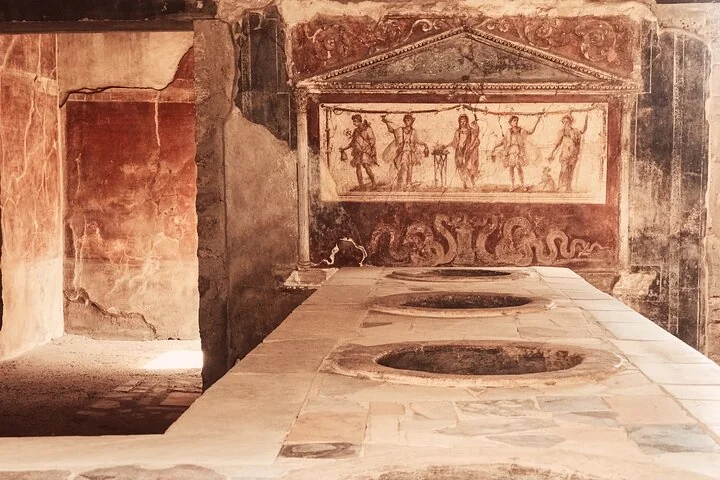
“Ad Cucumas” is one of those delightful surprises in Herculaneum: an ancient advertisement painted right onto the wall of a tavern, promoting wine by the jug. The text, still legible after two millennia, lists prices for different quantities and shows how everyday commerce was woven into the rhythm of the street. It’s a reminder that ancient Romans didn’t just build temples and villas — they sold drinks, compared bargains, and attracted customers with catchy signage long before paper menus or neon lights. Standing in front of it, you suddenly realize how familiar this little scene feels: the practical concerns of businesses and thirsty passersby haven’t changed all that much.
10
Casa del Bicentenario
Pass by
The Casa del Bicentenario is one of Herculaneum’s most impressive townhouses, revealing how refined Roman urban living could be. Vivid wall paintings, wooden partitions, and marble thresholds suggest rooms arranged for both family life and social display, while a small shrine with delicate frescoes hints at domestic religion. Archival photographs on site link modern excavation to early-20th-century discovery.
Set near the ancient shoreline, the house once enjoyed prime seaside views. Excavations here also yielded carbonized wooden writing tablets that recorded property and inheritance disputes, preserving rare traces of the household’s legal affairs and its active role in the civic life of the city.
Before you go
Ticket & redemption
Mobile or paper ticket accepted
One ticket covers the whole booking
Pickup & drop-off
We operate pick up in Naples, Sorrento, Pompeii, Salerno etc... from hotels, vacation rentals, train station, airport and cruise terminal/port. Please specify your pick-up place upon booking.
Good to know
Public transportation options are available nearby
Not recommended for travelers with spinal injuries
Not recommended for travelers with poor cardiovascular health
Travelers should have at least a moderate level of physical fitness
Please be aware that one day in not enough to visit all the coast. We normally manage to stop in one or two of the villages on the cost, beside of course Herculaneum. You will be free to decide with the support of your driver where would you prefer to stop and how long for.
Comfortable walking shoes and sun gear are recommended
For those not willing to take the entire walk inside Herculaneum, there are some of cafés and gift shops right outside the entrance
Accessibility
Service animals allowed
Specialized infant seats are available
Location
Corso Resina, 187, 80056, Italy
11
Stop 11
Pass by
The Sacello degli Augustali adds a political and religious layer to Herculaneum that many visitors don’t expect. This small temple-like building was dedicated to the imperial cult, where local elites honored the emperor as a living symbol of Rome’s power and unity. Inside, you can still make out fragments of frescoes depicting Hercules alongside members of the imperial family — a clever pairing that linked local mythology with imperial propaganda. Standing here, the ruins feel less like a frozen domestic town and more like a community plugged into the larger machinery of the Roman world. It’s a quiet spot, but one that helps explain how loyalty, status, and civic identity worked in a provincial city.
12
Stop 12
Pass by
The Casa del Tramezzo di Legno is instantly memorable for something exceptionally rare at Roman sites: its wooden partition wall. Carbonized by the eruption and preserved almost like a fossil, the folding screen once separated the reception area from the more private quarters of the house. Walking through the rooms, you can still read social choreography in the layout — where guests were welcomed, where business was conducted, and where family life retreated from view. Decorative details, surviving upper-story elements, and traces of furnishings make the space feel surprisingly lived-in. It’s one of those houses that collapses distance between past and present, reminding you that domestic privacy, hospitality, and status mattered to ancient Romans just as much as they do today.
13
Stop 13
Pass by
The Casa dello Scheletro — literally “House of the Skeleton” — is one of those places that stays with you long after the tour. As you step inside, the stark reality of an ancient life interrupted hits in a way that no mosaic ever can: the skeletal remains of a resident discovered here remind us that Herculaneum was not just a ruin, but a lived-in town. Around the bones, architectural details like fresco fragments, room divisions, and decorative flooring subtly reveal the rhythm of daily life before the eruption. It’s a humbling and powerful space where archaeology and humanity intersect, offering a quiet yet poignant moment to reflect on the people who once walked these same floors.
14
Amalfi Coast
Pass by
Considered one of the world’s most scenic coastal routes, the Amalfi Coast Drive winds along a dramatic cliff line between mountains and sea. As the road curves through tunnels and perched villages, the landscape shifts constantly—terraced lemon groves, pastel houses clinging to slopes, tiny harbors far below, and the blue expanse of the Mediterranean unfolding around each bend. The route is full of photo stops and viewpoints that reveal just how rugged and improbable this coastline is. Traveling with a private driver allows you to relax, enjoy the panorama, and fully experience the beauty that has drawn travelers here for centuries.
15
Ravello
1h
Perched high above the Amalfi Coast on a natural terrace, Ravello offers a quieter, more refined atmosphere than the seaside towns below. Long admired by artists, writers, and musicians, the town blends medieval architecture with sweeping sea views that seem to float above the coastline. With about an hour of free time, visitors can explore Ravello’s charming piazzas, artisan boutiques, and photogenic lanes at their own pace, or simply relax at a café while enjoying a panorama that has inspired travelers for generations.
Highlights:
• Piazza Duomo
Ravello’s elegant main square, anchored by the 11th-century Cathedral. The Duomo features bronze doors and a bright interior that reflects the town’s historic ties to the maritime Republic of Amalfi.
• Scenic Terraces & Artisan Shops
Ceramic workshops, linen boutiques, and lemon-based products line Ravello’s narrow streets, offering distinctive souvenirs in a relaxed, uncrowded setting.
16
Villa Cimbrone Gardens
30min
Set on the eastern edge of Ravello, the gardens of Villa Cimbrone offer one of the most dramatic panoramas on the Amalfi Coast. Designed in the early 20th century by an English patron with a passion for classical art and landscape design, the gardens blend shaded walkways, rose terraces, statues, and decorative follies that open onto sweeping views. The highlight is the celebrated Terrace of Infinity, where a balustrade lined with marble busts seems to float between sky and sea. Whether you wander slowly or simply come for the outlook, Villa Cimbrone captures Ravello’s quiet elegance and its enduring appeal to artists and travelers.
17
Villa Rufolo
15min
Located just off Ravello’s main square, Villa Rufolo was once the lavish residence of a powerful medieval family and later a stopping point for European artists on the Grand Tour. Its cloistered courtyards, Neo-Moorish arches, and tiered gardens reveal centuries of layered history, while the terraces open onto a soaring panorama of the Amalfi Coast far below. The villa famously inspired composer Richard Wagner, who found in its gardens the setting for scenes of Parsifal. Today visitors come to stroll the pathways, enjoy the botanical displays, or simply take in a view that has made Ravello synonymous with elegance and tranquility.
18
Minori
30min
Known as the “City of Taste,” Minori is a charming seaside town where everyday life still feels authentically local. Its small beach, gentle waterfront, and inviting pastry shops make it a refreshing pause along the Amalfi Coast. Minori has ancient roots—once a Roman maritime village—and you can still visit the remains of a 1st-century villa tucked into the town. Today it’s especially loved for its handmade pastas and lemon-based specialties, which fill the narrow lanes with sweet, bright aromas. Whether you stop for a stroll, a snack, or a view of the sea, Minori offers a quieter slice of coastal life.
19
Maiori
30min
Maiori stretches along one of the longest beaches on the Amalfi Coast, giving the town a more open and breezy feel compared to its cliffside neighbors. Once favored by the coastal princes of Amalfi, it has long been a hub for seaside trade and maritime culture. Today visitors enjoy its wide promenade, relaxed cafés, and easy access to the sea, making it a pleasant stop for a walk or a refreshment. Behind the waterfront, pastel houses climb toward the mountains, where old pathways and lemon terraces begin. Maiori offers a gentler and less crowded coastal experience while still showcasing the beauty that defines this iconic coastline.
20
Cetara
Pass by
As the road curves along the coast, you’ll catch views of Cetara, a small and remarkably authentic fishing village tucked between steep mountains and the sea. Its tiny harbor, colorful boats, and medieval watchtower reveal a place still centered around the daily catch. Known for its prized anchovy tradition, Cetara offers a snapshot of the Amalfi Coast before tourism—quiet, working, and deeply tied to the water.
21
Vietri sul Mare
Pass by
Visible from the coastal road as you approach Salerno, Vietri sul Mare stands out for its bright ceramic tiles and domed church glittering above the houses. Considered the artistic gateway to the Amalfi Coast, Vietri has produced distinctive hand-painted ceramics for centuries, a tradition still recognizable in shop signs, façades, and decorative details throughout town. Even from the road, the colors and patterns give Vietri a lively, creative character that contrasts with the rugged cliffs surrounding it.
 Skip the line
 Skip the line
 Skip the line
 Skip the line
 Skip the line
 Skip the line
 Skip the line
 Skip the line
 Special offer

