Every bookable experience in Italy, in one place — compared across GetYourGuide, Headout and Viator, ranked on reviews, booked on their site at their price.
Explore the Colosseum and Ancient Rome on a relaxing private tour with priority access tickets. Discover the secrets of gladiators and the grandeur of this amphitheater that once seated 60,000 spectators, with optional arena access.
Highlights
Private Guided Tour
Priority Access
Arena Access (Optional)
What's included
Arena Access (if option selected)
Colosseum entrance ticket valued at €18 per person
Pick-up from your hotel (if selected)
Entrance to the Colosseum and Foro Romano
3 hours guided tour
Professional blue badge guide
Colosseum reservation fee (valued at €2 per person)
Private Tour
Drop-off service (if option selected)
Note: Colosseum fees are as above. The remaining cost of the experience covers other services
Not included
Food And Drinks
Itinerary
1
Via dei Fori Imperiali
Pass by
Stretching elegantly between "Piazza Venezia" and the "Colosseum", Via dei Fori Imperiali is a majestic avenue carved through the heart of ancient Rome. Lined with the ruins of the Imperial Fora — Caesar’s, Augustus’, Nerva’s, and Trajan’s — it offers a breathtaking walk through millennia of history. Originally built under Mussolini between 1924 and 1932, the road both reveals and bisects key archaeological zones, making it a dramatic ribbon of civilization where past and present intersect.
2
Roman Forum
1h
The Roman Forum, also known by its Latin name Forum Romanum, is a rectangular forum surrounded by the ruins of several important ancient government buildings at the center of the city of Rome.The political and business centre of ancient Rome, the warn away paths are covered in history. This is where the citizens came to listen to speeches, to meet the senators or to see people like Julius Caesar or Cicero. The ruins tell a story, and it is the story of Rome and its politics, with the likes of the ancient Curia (the Senate) that is still visible, but also with the impressive marble columns of temples which were erected for the first time in V century BC.
3
Curia Julia
5min
The Curia Julia, commissioned by Julius Caesar and completed under Augustus in 29 BC, served as the meeting place of the Roman Senate. Located in the Roman Forum, its imposing rectangular structure symbolized the political heart of ancient Rome. Remarkably well preserved, it still conveys the power and authority of the Senate that once shaped the destiny of the Empire.
4
Tempio del Divo Giulio
5min
Erected in the Roman Forum by Augustus in 29 BC, the Temple of Divus Julius honored the deified Julius Caesar after his assassination. Standing on the site of Caesar’s cremation, the temple became a place of cult and political symbolism, where citizens could pay homage to Rome’s first deified leader. Today, only ruins remain, yet the site continues to embody the turning point from Republic to Empire.
5
Tempio di Vesta
5min
One of the most sacred sites of ancient Rome, the Temple of Vesta was dedicated to the goddess of the hearth. Its circular design symbolized eternity and the continuity of the Roman state, while within burned the eternal flame, tended by the Vestal Virgins. Though only fragments remain today, the temple still evokes the deep spiritual life of the Roman Forum.
6
Arco di Tito
5min
The Arch of Titus, built in 81 AD by Emperor Domitian, commemorates the victories of his brother Titus, including the conquest of Jerusalem. Standing at the entrance to the Roman Forum along the Via Sacra, the triumphal arch is decorated with detailed reliefs depicting the spoils of war and the emperor’s triumphal procession. It remains a powerful symbol of Rome’s imperial glory and architectural mastery.
7
Arch of Constantine
5min
The Arch of Constantine, erected in 315 AD near the Colosseum, celebrates Emperor Constantine’s victory over Maxentius at the Battle of the Milvian Bridge. Adorned with reliefs and sculptures reused from earlier monuments, it symbolizes both the grandeur of imperial Rome and the transition to a new era under Constantine’s rule. Today, it stands as one of the most iconic triumphal arches of the ancient world.
8
Colosseum
1h 30min
Enjoy a private tour with your personal storyteller by entering the Colosseum, a true blessing especially during hot and crowded summer days! Your private guide will help your imagination with visual aids and reconstructions of ancient buildings and you will experience how Roman history comes to life thanks to an expert storyteller. Retrace the same sites you got to know in your favorite Ancient Rome movies like “the Gladiator”, “Spartacus”, “Ben-Hur”. The Colosseum or Coliseum, also known as the Flavian Amphitheatre, is an oval amphitheatre in the centre of the city of Rome. Built of travertine limestone, tuff, and brick-faced concrete, it was the largest amphitheatre ever built at the time and held aprox 60,000 spectators.
Before you go
Ticket & redemption
Mobile or paper ticket accepted
One ticket covers the whole booking
Pickup & drop-off
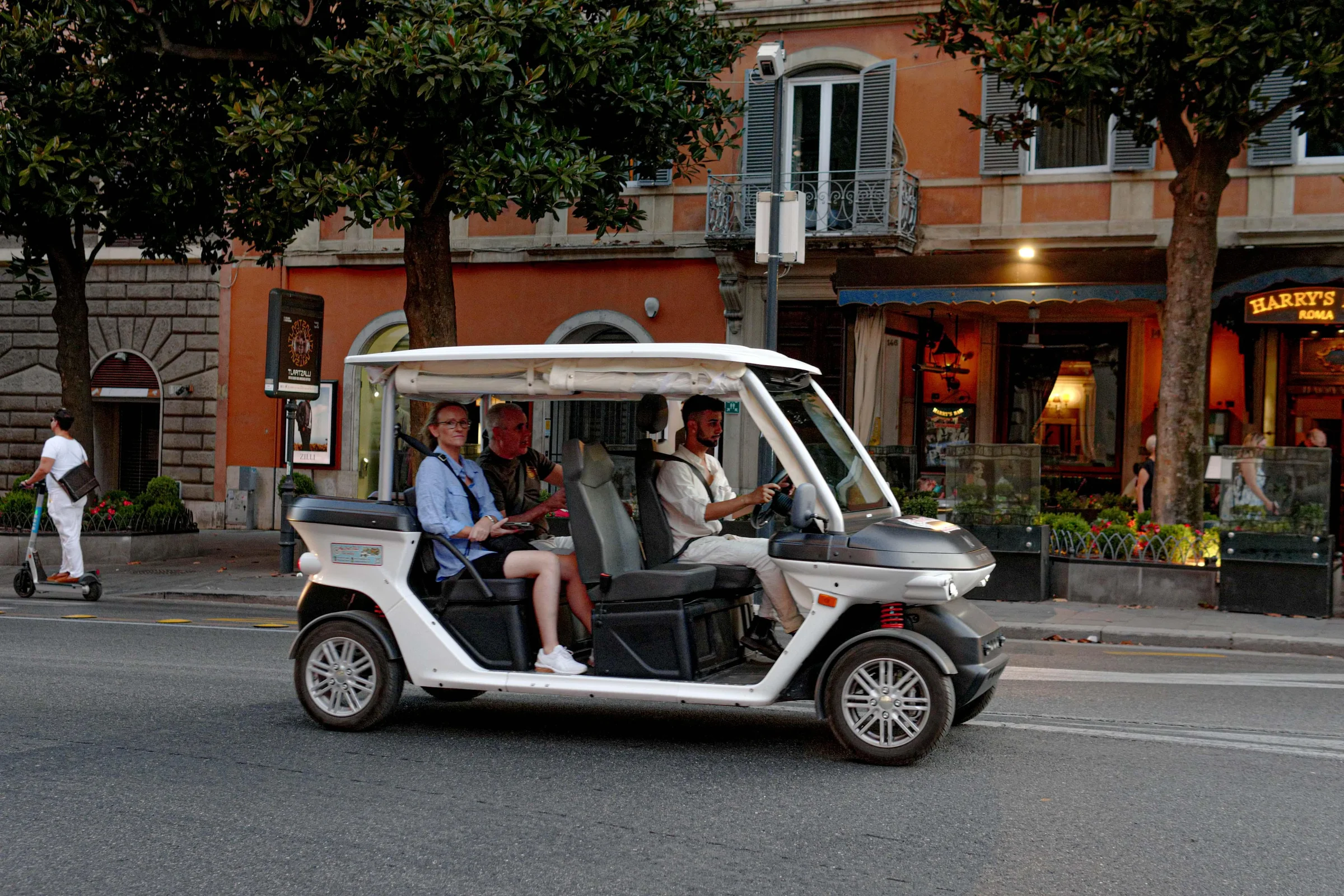
You will meet your private driver speaking English in the lobby of your hotel or in front of your AirBnB and you'll go to meet your private guide (ONLY with Pick Up option / Transfer selected)
Accessibility
Wheelchair accessible
Infants and small children can ride in a pram or stroller
Suitable for all physical fitness levels
Good to know
Public transportation options are available nearby
Transportation options are wheelchair accessible
All areas and surfaces are wheelchair accessible
Dress code is casual
Comfortable walking shoes are recommended
A bottle of water will be always helpful
Important Information for Your Visit To ensure a smooth entry, please remember that all members of your group must present a valid, government-issued photo ID (a photo of your passport is also acceptable). Tickets are strictly personal, and the names provided at the time of booking must match exactly the names shown on your passport. Please note that only the person listed on the ticket will be admitted; unfortunately, last-minute substitutions are not allowed. The Colosseum Archaeological Park requires that the full official name and surname shown on your ID match the information on your entry ticket. For this reason, we kindly ask you to provide your complete legal names at the time of booking; nicknames or variations cannot be accepted.




 Skip the line
 Skip the line