Every bookable experience in Italy, in one place — compared across GetYourGuide, Headout and Viator, ranked on reviews, booked on their site at their price.
© 2026 LivingLocal. All rights reserved.
We use only the cookies this site needs to work. Analytics (Google, PostHog) load only if you agree.
From
$189per personFor a full refund, cancel at least 24 hours before the scheduled departure time.
Good for
Skip the lineRating 4.5(1,229), 1,229 reviews·City tour·Duration 8 h
Skip the lineRating 4.9(188), 188 reviews·City tour·Duration 4 h – 5 h
Skip the lineRating 4.7(1,527), 1,527 reviews·Day trip·Duration 8 h
PopularRating 5.0(49), 49 reviews·City tour·Duration 8 h – 9 h

Rating 5.0(15), 15 reviews·City tour·Duration 9 h

Rating 4.7(112), 112 reviews·City tour·Duration 8 h 30 min
Skip the lineRating 5.0(5), 5 reviews·City tour·Duration 4 h – 5 h

Rating 4.8(10), 10 reviews·City tour·Duration 4 h – 5 h

Rating 4.9(1,359), 1,359 reviews·Cruise·Duration 7 h – 8 h

Rating 4.7(1,217), 1,217 reviews·Food & drink·Duration 8 h 45 min

Rating 5.0(770), 770 reviews·Food & drink·Duration 4 h

Rating 4.8(508), 508 reviews·Cruise·Duration 8 h – 9 h
Viator
Explore the ancient cities of Pompeii and Herculaneum, buried by the Vesuvius eruption in 79 AD and preserved almost perfectly. Walk through eerie streets, enter houses and restaurants with authorized guides, and uncover hidden treasures of these UNESCO World Heritage sites. An unforgettable journey into the region's tragic history, complete with a delightful light lunch.
Archaeological Park of Pompeii
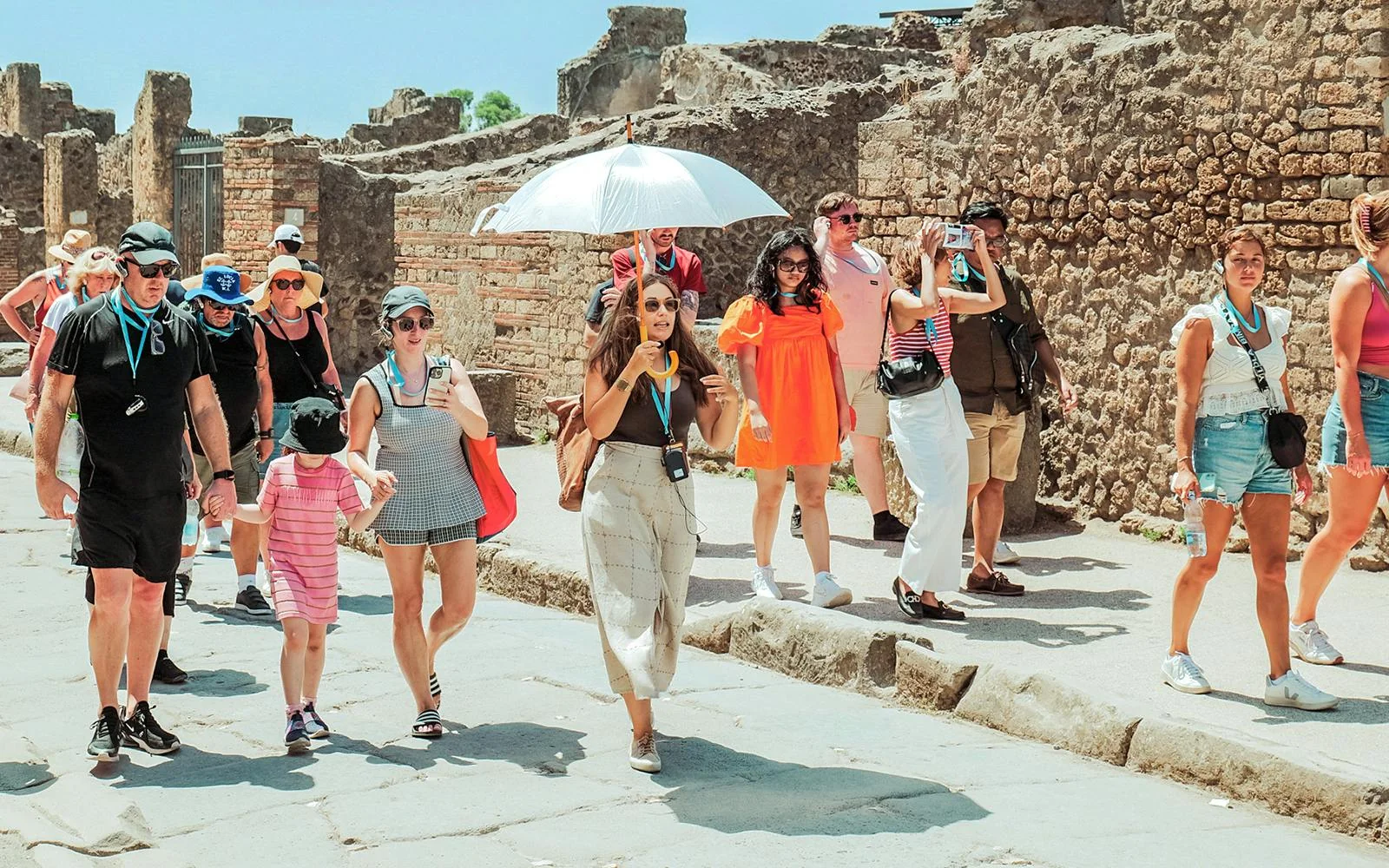
2hThe ruins of Pompeii are a vast archaeological site in the southern Campania region, near the coast of the Gulf of Naples. Once a thriving and sophisticated Roman city, Pompeii was buried under meters of ash and pumice after the catastrophic eruption of Mount Vesuvius in 79 AD. The preserved site features remain of excavated streets and houses that visitors can freely explore.
Foro de Pompeya
The Civil Forum represents the center of the daily life of the city, all the main public buildings for the administration of the city and justice, for the management of business, for commercial activities, such as markets, overlook it, in addition to the main places of city worship.
Tempio di Giove Capitolino
The Temple of Jupiter dominates the northern side of the Forum, and Vesuvius rises spectacularly behind it. With the deduction of the colony (80 BC) the temple was the subject of a radical renovation and became a real Capitolium, with the three cult statues of Jupiter, Juno and Minerva, which imitated those of the Capitolium in Rome, placed on a high base, so as to make them visible to those passing through the Forum square.
Macellum
The Macellum consists of a tuff Quadri-porticus with a hall for worship in an elevated position on the eastern side, in line with the entrance. The Macellum of Pompeii was nothing more than the city market where people could buy food. Located north-east of the Forum, the complex had to remain out of the way from the square so as not to create too much crowding, given the high number of people who certainly frequented it. The walls of the porticoes were decorated with scenes from daily life, such as selling fish and poultry, and mythological subjects.
Via dell’Abbondanza
“Via dell 'Abbondanza” is one of the main streets of the ancient city of Pompeii, in Campania, which connected the Forum with the Amphitheatre.
Stabian Baths (Terme Stabiane)
The Stabian Baths were built at different times. The initial phase of construction dates back to the 4th BC. The main entrance by via dell'Abbondanza leads to a large courtyard. The pool is found to the left, whereas a colonnade is found to the right, which leads to the men's quarters, which are split into the apodyterium, with the frigidarium, which leads to the tepidarium and then to the calidarium.The heating was guaranteed by a piping system in the walls and double floors that circulated the hot air coming from the furnaces and from mobile braziers. The women's quarters, close to the men's quarters, were split the same way in the apodyterium, tepidarium and calidarium. However, all were smaller and had no rich decorations as the men's quarters. The baths that we can admire today were built in the 2nd century BC, a period in which Pompeii underwent a major building renovation. In the spa not only did people bathe, but they also discussed politics, battles, trials, women.
Lupanar
The brothel of Pompeii, with its erotic paintings, is one of the best-known buildings of the excavations and had the function of a brothel. The prostitutes in the brothel were mostly Greek and Oriental slaves. The building has two floors. The homes of the owner and the slaves are at the top and there are five rooms at the bottom, all fitted with a built-in bed. The brothel is named from Lupa, a Latin word meaning prostitute.
Teatro Grande
The Large Theatre was built around the middle of the 2nd century BC and significantly restored according to the Roman style. In the theatre they represented comedies and tragedies of Greek-Roman tradition. The theatre was the first large public building completely freed from the deposits of the eruption.
Casa del Salone Nero
The house of the black salon owes its name to its party hall entirely painted in black with geometric patterns. In this house were found waxed tablets of L. Venidius Ennychus who was supposed to have owned the house. The tablets speak of her eligibility for Augustale, the purchase of a slave, and the birth of a daughter.
Archeological Park of Herculaneum
2hThe ruins of Herculaneum are an archaeological site in the southern Campania region, near the coast of the Gulf of Naples. Once a small and sophisticated Roman city, Herculaneum was buried under meters of ash and pumice after the catastrophic eruption of Vesuvius in 79 A.D. The site is still perfectly preserved, has remains of streets, houses and villas excavated that visitors can admire.
Stop 11
The luxurious house with sea view terrace belonged to Q. Granius Verus, a slave freed shortly before the destruction of Herculaneum. In the garden there are two statues of deer assaulted by a pack of dogs, from these the house takes its name
Casa di Nettuno e Anfitrite
Enchanting are the mosaics in glass paste, (very expensive for the time), with floral and hunting scenes and in a central position the mosaic with Neptune and Amphitrite, (the marine deity and his wife).
Stop 13
The skeleton house is probably the result of the aggregation of three smaller buildings, and its name derives from the discovery of human remains in a second-floor room in 1831.
Stop 14
The Sacellum of the Augustales was built near the forum when Emperor Augustus was still alive and in power. It is a building with a quadrangular plan that preserves the splendid frescoes that represent Hercules entering the Olympus in the company of Jupiter, Juno, Minerva and Hercules against Achelous. The janitor’s skeleton was found in his room lying on the bed.
Stop 15
The house of the Hotel is a house of roman times, buried during the eruption of Vesuvius in 79 and found following the archaeological excavations of Herculaneum. The house of the Hotel is located on the edge of the hill, in a panoramic position, with its two thousand hundred and fifty square meters is the largest house of Herculaneum so far discovered and is also the only one of the city to own a spa district was for these reasons considered at first to be a hotel.