Every bookable experience in Italy, in one place — compared across GetYourGuide, Headout and Viator, ranked on reviews, booked on their site at their price.
© 2026 LivingLocal. All rights reserved.
We use only the cookies this site needs to work. Analytics (Google, PostHog) load only if you agree.
See all Torre del Mangia tours
From
$4per personFor a full refund, cancel at least 24 hours before the scheduled departure time.
Good for

City tour·Duration 9 h 30 min

City tour·Duration 1 h – 6 h

Rating 5.0(1), 1 reviews·City tour·Duration 3 h

Rating 4.0(3), 3 reviews·City tour·Duration 2 h – 3 h

City tour·Duration 3 h

Rating 5.0(11), 11 reviews·City tour·Duration 3 h

City tour·Duration 2 h

City tour·Duration 3 h – 4 h

Rating 4.5(3,799), 3,799 reviews·Food & drink·Duration 12 h

Rating 4.8(394), 394 reviews·Food & drink·Duration 1 h
PopularRating 4.9(122), 122 reviews·Food & drink·Duration 4 h

Rating 4.8(80), 80 reviews·Food & drink·Duration 3 h
Viator
Explore magnificent Siena and its surroundings with our self-guided audio tour app. Start at the stunning Piazza del Campo, admire the Torre del Mangia and the Duomo, and wander through the historic contrade neighborhoods. Discover Tuscany's hidden gems following your own itinerary.
Not included
Piazza del Campo
1hThis extraordinary shell-shaped piazza has served as Siena's living room since the 14th century, its sloping brick pavement divided into nine segments representing the Council of Nine who governed during Siena's golden age. Twice each summer, the piazza transforms into a racetrack for the Palio, where bareback riders representing the city's seventeen contrade compete in a 90-second spectacle that has captivated Sienese for over 600 years. Cafe tables line the curved perimeter where visitors and locals gather to people-watch, savor gelato, and absorb the medieval architecture.
Palazzo Pubblico E Museo Civico
Pass bySiena's magnificent Gothic town hall has anchored the Piazza del Campo since 1310, its elegant facade of brick and travertine marble crowned by the soaring Torre del Mangia. Inside, the Museo Civico houses Ambrogio Lorenzetti's revolutionary Allegory of Good and Bad Government, the first secular frescoes of the Renaissance, alongside Simone Martini's stunning Maestà. The ornate Sala del Mappamondo, Sala della Pace, and Chapel preserve the artistic and political ambitions of medieval Siena.
Torre del Mangia
Pass byRising 102 meters above Piazza del Campo, this elegant bell tower was deliberately built to match the height of Siena's cathedral, symbolizing the equal power of church and state in the medieval republic. The tower takes its name from its first bell-ringer, Giovanni di Balduccio, nicknamed Mangiaguadagni (profit-eater) for his spendthrift ways. Climbing the 400 steps rewards visitors with breathtaking views across terracotta rooftops to the Tuscan hills.
Duomo di Siena
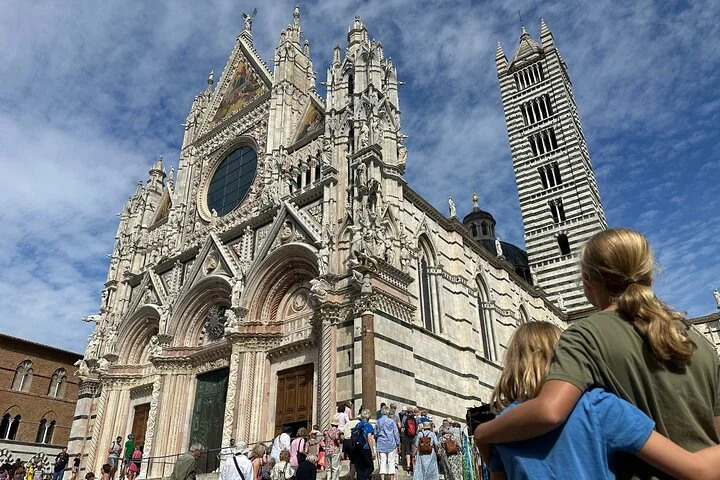
Pass bySiena's cathedral ranks among Italy's most spectacular churches, its black and white striped marble facade and interior creating a dazzling geometric pattern that influenced Tuscan architecture for centuries. The Piccolomini Library preserves Pinturicchio's luminous frescoes depicting the life of Pope Pius II, while Nicola Pisano's carved pulpit and works by Michelangelo and Bernini fill every corner with masterpieces. The unfinished nave extension reveals the cathedral's abandoned ambition before the Black Death devastated the city.
Battistero di San Giovanni
30minLocated beneath the cathedral choir, this Gothic baptistery houses a magnificent marble font decorated with bronze panels by the greatest sculptors of the early Renaissance including Ghiberti, Donatello, and Jacopo della Quercia. The hexagonal font's gilded bronze reliefs depicting the life of John the Baptist represent a pivotal moment in art history when Florence and Siena's finest artists collaborated on a single masterpiece. The baptistery's frescoed vaults create an atmosphere of sacred beauty.
Via di Citta
30minSiena's most elegant street curves from the Campo toward the Duomo, lined with Gothic palaces, artisan workshops, and boutiques selling Sienese specialties from panforte to hand-painted ceramics. The Palazzo Chigi-Saracini houses the prestigious Accademia Musicale Chigiana, its courtyard concerts continuing a tradition of Sienese musical excellence. Window shopping along this atmospheric thoroughfare reveals traditional craft workshops where artisans practice techniques passed down through generations.
Stop 7
30minThis massive brick Gothic church dominates Siena's skyline from the hill of Camporegio, its austere interior serving as the spiritual home of St. Catherine of Siena, the city's beloved mystic and Doctor of the Church. The Chapel of St. Catherine preserves the saint's head in a gilded reliquary alongside frescoes by Sodoma depicting her ecstasies and miracles. The church's elevated position offers stunning views across the valley to the Duomo.
Santuario di Santa Caterina
30minThe childhood home of St. Catherine has been transformed into a complex of chapels and oratories preserving the rooms where the future saint experienced her mystical visions. Catherine's influence on the medieval church, including persuading Pope Gregory XI to return from Avignon to Rome, made this humble dyer's house a pilgrimage destination decorated with Renaissance frescoes. The intimate spaces convey the domestic origins of one of Christianity's most remarkable women.
Pinacoteca Nazionale
Pass byHoused in the Gothic Palazzo Buonsignori, Siena's picture gallery presents the definitive collection of Sienese painting from the 12th to 17th centuries, tracing a distinct artistic tradition that rivaled Florence. Duccio di Buoninsegna, Simone Martini, and the Lorenzetti brothers represent the golden age of Sienese Gothic art, their shimmering gold backgrounds and elegant figures establishing a style that influenced European painting for generations. The chronological arrangement reveals how Sienese artists balanced tradition with innovation.
Contrada della Torre
1hSiena's seventeen contrade each possess a parish church, museum, and distinctive fountain where horses are blessed before the Palio and babies are baptized into their contrada's identity. Walking between these neighborhood fountains reveals the fierce local pride that has divided Siena into competing territories since medieval times, each with its own animal symbol and centuries of victories and defeats. The fountains provide destinations for exploring Siena's residential quarters where flags hang from windows.
Fortezza Medicea
This massive brick fortress was built by Cosimo I de' Medici after Florence's conquest of Siena in 1555, its star-shaped bastions designed to prevent any future rebellion by the subjugated city. Today the fortress has been transformed into a peaceful public park, its grassy ramparts offering sweeping views across Siena and the surrounding countryside. The Enoteca Italiana wine bar occupies the fortress vaults, offering tastings from across Italy in atmospheric brick cellars.
Basilica dell'Osservanza
30minPerched on a hillside outside Siena's walls, this Renaissance church and monastery was founded by San Bernardino, whose fiery preaching once convinced Sienese women to burn their cosmetics in the Campo. The church's peaceful cloister, terracotta decorations by the Della Robbia workshop, and the saint's simple cell provide a contemplative escape from the busy historic center. The walk through olive groves offers beautiful views of Siena's skyline.
Stop 13
30minSiena's principal commercial street stretches from Piazza Salimbeni through the heart of the historic center, its medieval palaces now housing banks, boutiques, and cafes continuing centuries of mercantile tradition. The Monte dei Paschi di Siena, founded in 1472 and headquartered in the magnificent Palazzo Salimbeni, claims to be the world's oldest continuously operating bank. The street's daily passeggiata brings Sienese of all ages strolling past Gothic and Renaissance facades.
Stop 14
Pass byOne of Europe's oldest hospitals has been transformed into a vast museum complex housing archaeological collections, Renaissance frescoes, and contemporary art exhibitions in former wards and pilgrims' halls. The Pellegrinaio's vivid frescoes depicting scenes of hospital life provide a remarkable window into medieval charity and medicine, while underground passages reveal Etruscan and Roman remains beneath. The museum's scope matches the Duomo across the piazza in ambition if not fame.
Orto Botanico di Siena
30minTucked away in a quiet corner near the Duomo, Siena's botanical garden occupies terraced slopes where medicinal plants have been cultivated since 1588. The intimate gardens present a living collection of Tuscan flora, exotic specimens, and historical medicinal plants labeled with their traditional uses. The peaceful atmosphere provides a perfect retreat for anyone seeking a quiet bench beneath ancient trees away from the tourist crowds.