Every bookable experience in Italy, in one place — compared across GetYourGuide, Headout and Viator, ranked on reviews, booked on their site at their price.
© 2026 LivingLocal. All rights reserved.
We use only the cookies this site needs to work. Analytics (Google, PostHog) load only if you agree.
See all St Mark's Basilica tours
From
$171per personFor a full refund, cancel at least 24 hours before the scheduled departure time.
Good for
Skip the lineRating 4.8(4,761), 4,761 reviews·Cruise·Duration 4 h – 6 h
Skip the lineRating 4.7(652), 652 reviews·Cruise·Duration 45 min

Rating 4.8(63), 63 reviews·Cruise·Duration 1 h

Rating 4.8(53), 53 reviews·Cruise·Duration 1 h 30 min
Skip the lineRating 4.8(94), 94 reviews·Cruise·Duration 4 h – 6 h

Rating 5.0(91), 91 reviews·Cruise·Duration 2 h 30 min
Skip the lineRating 4.8(763), 763 reviews·City tour·Duration 1 h 15 min

Rating 5.0(15), 15 reviews·Cruise·Duration 2 h

Rating 4.6(13,673), 13,673 reviews·Cruise·Duration 24 h
Skip the lineRating 4.3(3,107), 3,107 reviews·Theme park·Duration 1 h
Skip the lineRating 4.4(1,624), 1,624 reviews·Theme park·Duration 168 h
Skip the lineRating 4.1(1,539), 1,539 reviews·Theme park·Duration 24 h
Viator
Experience Venice stress-free with the All-Inclusive Venice City Pass. It features skip-the-line access to St. Mark's Basilica with a guided morning tour, a 20-30 minute gondola ride, and exploration of Murano, Burano, and Torcello islands. Enjoy entry to over 20 attractions, including Doge's Palace, plus unlimited public transport.
Not included
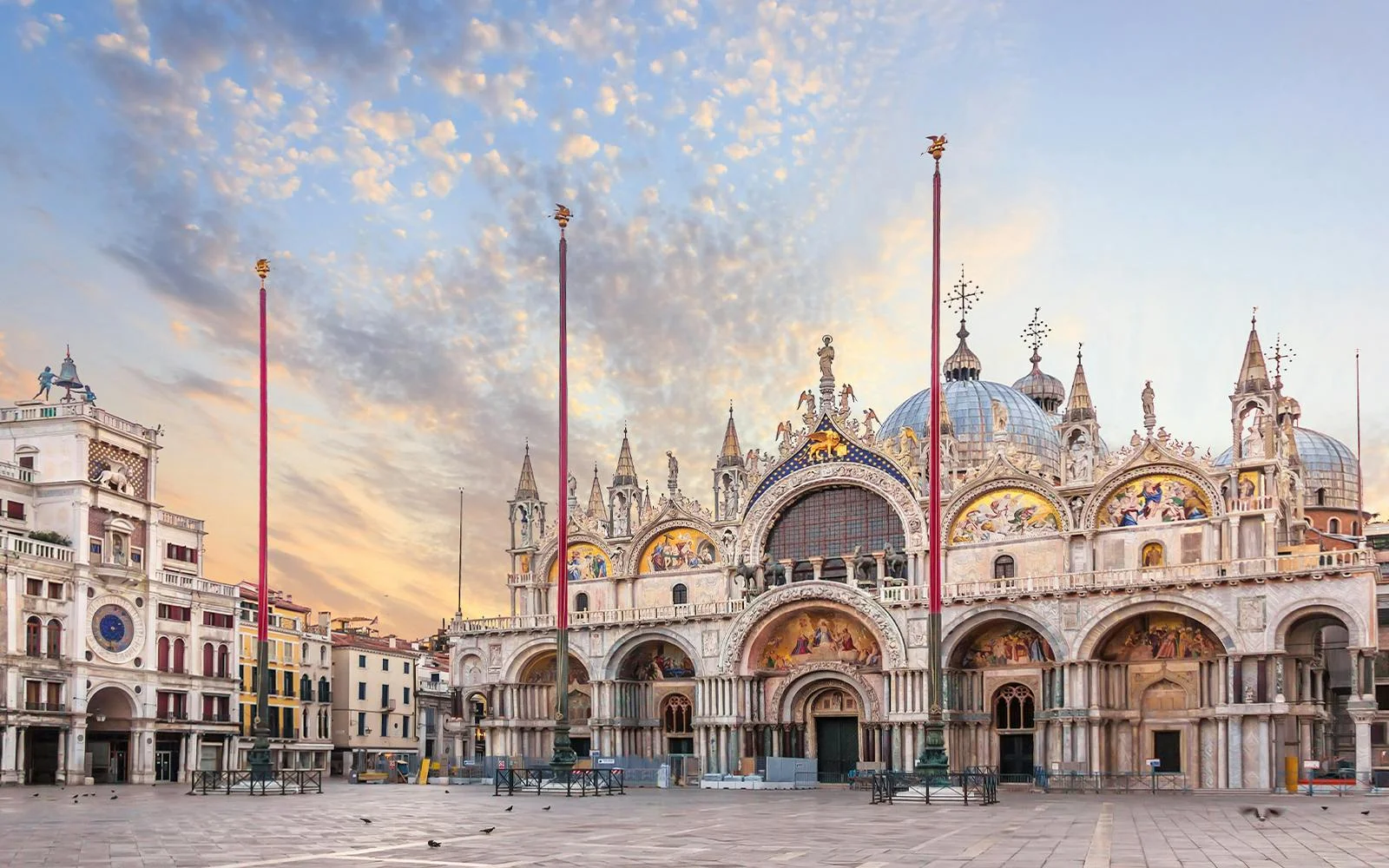
St. Mark's Basilica
45minSt Mark’s Basilica in Venice, originally intended as a private chapel for the Doge, is one of Italy’s most spectacular cathedrals. The basilica was built to house the relics of St Mark the Evangelist, which had been stolen in Alexandria, Egypt. Today, St Mark’s Basilica is famous for its golden mosaics, among other things. Admission with a tour guide who accompanies the group through the museum
Stop 2
2hThe Doge's Palace in Venice, an outstanding example of Gothic architecture, was the seat of the Doge and is now one of the most visited sights in the city. Originally built in the 9th century, the palace served as the residence and political centre of the Republic of Venice. Today's palace was built in the 14th and 15th centuries and impresses with its ornate façade, large inner courtyard and magnificent halls such as the Great Council Chamber and the Golden Hall. Area of validity of the ticket: · Doge's Palace (Palazzo Ducale) · Correr Museum (Museo Correr) · National Archaeological Museum (Museo Archeologico Nazionale) · Marciana National Library (Sale Monumentali della Biblioteca Nazionale Marciana)
Ca' Rezzonico
1hThe palace is one of the few Venetian noble palaces that is open to the public today, and provides a valuable insight into the life of the rich Venetian upper class in the 18th century. It now houses the Museo del Settecento Veneziano, with numerous works of art and interior decorations from one of the absolute heyday of Venetian painting and art. It contains works from the late Baroque, Rococo and early Classicism periods, including paintings and frescoes by Pietro Longhi, Canaletto, Francesco Guardi, and the father and son Tiepolo, as well as furniture and fittings that were brought here from other palaces and villas.
Stop 4
1hThe Basilica di San Pietro di Castello in Venice is an impressive, historic building located off the beaten track on the island of the same name, Castello. This church, which was once the main cathedral in Venice, combines Romanesque, Gothic and Renaissance elements in its architecture. The marble-clad bell tower is particularly striking and is the only church in Venice with such a tower.
Stop 5
1hThe museum is located at the historic palace of Podestà of Torcello, in Piazza Galuppi, Burano, seat of the famous Burano Lace School from 1872 to 1970. Rare and precious pieces offer a complete overview of the history and artistry of the Venetian and lagoon’s laces, from its origins to the present day are on display, in a picturesque setting decorated in the typical colours of the island.
Ca' Pesaro Galleria Internazionale d'Arte Moderna
1hThe International Gallery of Modern Art in Ca’ Pesaro contains important 19th- and 20th-century collections of paintings and sculptures, including masterpieces by Gustav Klimt and Auguste Rodin and remarkable works by artists such as Medardo Rosso, Adolfo Wildt and Giacomo Balla, as well as a rich selection of works by other Italian artists and an important section on graphic art. The second floor of the monumental palace is home to temporary exhibitions and the third floor hosts the Museum of Oriental Art.
Casa di Carlo Goldoni
1hCarlo Osvaldo Goldoni (25 February 1707 – 6 February 1793) was an Italian playwright and librettist from the Republic of Venice. His works include some of the most famous and popular plays in Italy. Audiences appreciate Goldoni’s plays for their ingenious blend of wit and honesty. In his memoirs, Goldoni particularly remembers the palace where he was born and grew up. Today, this palace is a museum in his honour. It is also home to an institute for theatre studies.
Chiesa di San Sebastiano
1hThe Chiesa di San Sebastiano is a fascinating church in Venice that delights art lovers and history buffs alike. The church is particularly famous for being home to the life’s work of the artist Paolo Veronese. San Sebastiano, opened in its current form in 1546, contains a cycle of paintings, several paintings with scenes from the Old Testament, frescoes and the altarpiece by Veronese. A particular highlight in the Chiesa di San Sebastiano is his painting ‘The Martyr Santa Lucia’, an outstanding example of 16th century Venetian painting. Fittingly, the tomb of this famous artist is also located in the church.
Museo Correr
1hThe Correr Museum is located directly on St Mark’s Square, in the Napoleonic wing, which was furnished as a residence for the rulers. The Napoleonic wing, with its two monumental façades, enchanting portico, airy salon and magnificent ballroom, still displays many of the typical features of the Bonaparte and Habsburg eras: the architecture and fresco decorations, as well as the neoclassical furnishings, are important witnesses to the culture and stylistic idioms of an era. Equally worth seeing are the stately rooms that were furnished for the Habsburg court during the Austrian period, including the apartment of Empress Sissi. The magnificent rooms of the palace are decorated with valuable furniture, paintings and decorations, offering visitors an insight into the royal history of Venice.
Museo Leonardo da Vinci
1hThe Leonardo da Vinci Museum in Venice is an exciting and interactive exhibition that focuses on the life and works of da Vinci. Da Vinci, who lived during the 15th and 16th centuries, is considered one of the greatest geniuses of all time, with his works as an artist, engineer, scientist and inventor.
Museo del Vetro
1hThe museum's glass art collection is considered one of the most extensive in the world and is presented in seven chronologically arranged sections from antiquity to the present day. The last three sections of the exhibition are dedicated to the ‘rebirth’ of Murano glass, which has been in high demand again since the second half of the 19th century. You can admire both classical and Art Nouveau objects, as well as modern and contemporary works.
P.za San Marco, 328, 30100 Venezia Ve, Italy, 30124, Italy
Palazzo Mocenigo
1hThe museum houses the vast collections of ancient fabrics and clothes belonging to the Venice City Museums, with a section dedicated to perfume. It is meant to be a Study Centre for the history of fabrics, costumes and fashion. The rooms skilfully evoke the different aspects of the life and activities of a Venetian nobleman between the 17th and 18th century.
Scuola Grande Di San Rocco
1hThe Scuola San Rocco is one of the great Scuole, or brotherhoods, in Venice. These were founded from the 13th century onwards and were important religious and social institutions. The guild building of the largest Scuole, di San Rocco, was decorated with paintings and ceiling frescoes by the famous Venetian artist Jacopo Tintoretto over a period of 20 years.