Every bookable experience in Italy, in one place — compared across GetYourGuide, Headout and Viator, ranked on reviews, booked on their site at their price.
Start your morning the Roman way with a delicious Italian breakfast in the Monti neighborhood and discover the city comfortably in an eco-friendly golf cart. Your local guide will take you past iconic sights including the Colosseum, Circus Maximus, and the scenic Orange Garden on Aventine Hill.
Highlights
Traditional breakfast
Eco-friendly golf cart
Iconic sights
What's included
Electric golf cart
Professional guide
Coffee and croissant
Small group
Itinerary
1
Colosseum
15min
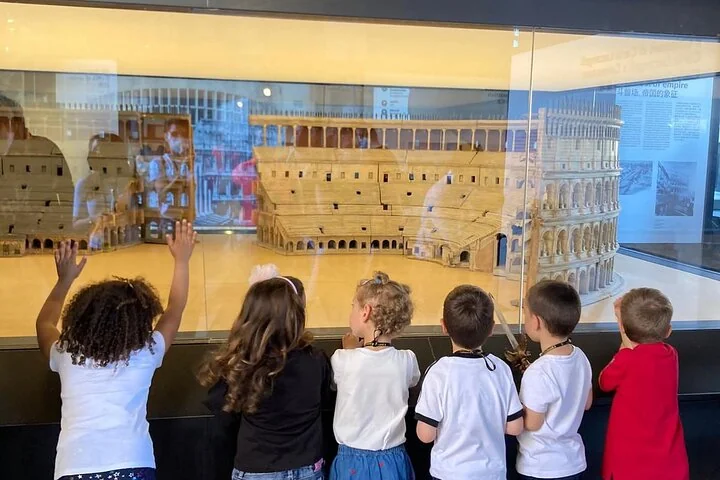
As you stand here outside the Colosseum, it's easy to think of gladiator battles, but they were only one part of the story. This building was a powerful symbol of the Roman Empire, showcasing its engineering, wealth, and authority. It welcomed tens of thousands of spectators for public spectacles and celebrations, reminding everyone of the emperor's power and Rome's greatness. Nearly 2,000 years later, despite earthquakes and centuries of change, the Colosseum remains one of the world's most recognizable landmarks and an enduring symbol of ancient Rome.
2
Palatine Hill
Pass by
During the Roman Empire, Palatine Hill became the most prestigious address in Rome. Emperors including Augustus, Tiberius, and Domitian built magnificent palaces here overlooking the Roman Forum and the Circus Maximus. In fact, the English word "palace" comes from the name Palatine.
Today, the ruins you see are the remains of those imperial residences, making this hill one of the most important archaeological sites in Rome.
3
Circo Massimo
Pass by
The Circus Maximus was primarily used for chariot races, the most popular sport in ancient Rome. Teams identified by colors—Red, White, Blue, and Green—competed at incredible speeds around the central barrier, known as the spina. Crashes were common and dangerous, making the races thrilling for the crowd.
The track was about 600 meters long, with races usually lasting seven laps. Emperors often attended these events, using them to celebrate victories, entertain the public, and strengthen their popularity.
4
Buco della Serratura
20min
At first glance, it's just an ordinary keyhole in a green door. But when you look through it, you'll see a perfectly framed view of the dome of St. Peter's Basilica, centered at the end of a beautiful garden avenue.
The door belongs to the headquarters of the Sovereign Military Order of Malta, a unique institution that has existed for nearly 1,000 years. Although it isn't a country in the usual sense, the Order has diplomatic relations with many nations and enjoys a special international status.
One of the reasons this view is so special is that you're looking through three jurisdictions at once: you are standing in Italy, looking through property belonging to the Order of Malta, and seeing the dome of Vatican City in the distance.
5
Mouth Of Truth
15min
The large marble face dates back to ancient Rome and is believed to be about 2,000 years old. Historians think it was originally a decorative drain cover or part of an ancient fountain, rather than a lie detector.
According to medieval legend, anyone who tells a lie while placing their hand inside the mouth will have it bitten off. Although there's no evidence the statue ever did that, the story has fascinated visitors for centuries.
The Mouth of Truth became internationally famous after appearing in the 1953 film Roman Holiday, starring Audrey Hepburn and Gregory Peck. In one memorable scene, Gregory Peck pretends to lose his hand, creating one of cinema's most iconic moments.
Today, visitors from around the world line up to place their hand inside the mouth, take a photo, and test the ancient legend for themselves. Whether you believe the story or not, it's one of Rome's most entertaining traditions.
6
Tempio Di Ercole Vincitore
Pass by
The temple has a distinctive circular design, surrounded by 20 Corinthian marble columns, making it one of the best-preserved examples of ancient Roman religious architecture.
This area, near the ancient cattle market and the River Tiber, was a busy commercial district. Merchants and traders would come here to pray to Hercules for protection, strength, and success in their business.
One reason the temple survived for over 2,000 years is that, during the Middle Ages, it was converted into a Christian church. This helped preserve the structure while many other ancient temples were dismantled for their stone.
7
Teatro di Marcello
10min
The Theatre of Marcellus is one of the best-preserved ancient theatres in Rome, built at the end of the 1st century BC. It was started by Julius Caesar and completed by Emperor Augustus around 13 BC, who dedicated it to his nephew and heir, Marcus Claudius Marcellus.
This magnificent theatre hosted public performances such as plays, music, and poetry recitals, entertaining thousands of Roman citizens. Its curved rows of arches and architectural style later influenced the design of the Colosseum.
Over the centuries, the theatre changed from a place of entertainment into a medieval fortress and later a Renaissance palace. Today, ancient Roman arches stand together with later buildings, showing how Rome has continuously transformed while preserving its history.
8
Stop 8
20min
Ahead of us is Capitoline Hill, the smallest but perhaps the most important of Rome’s Seven Hills. This hill was considered the symbolic center of ancient Rome, where religion, politics, and power came together.
In ancient times, the Romans built their most important temples here, and the hill became a symbol of victory and authority. Today, the Renaissance buildings on top give the hill a completely different appearance, thanks to the design of Michelangelo.
From this viewpoint, you can see how Rome tells its story through layers: the ruins of the ancient city below, the Renaissance architecture above, and the modern city surrounding them. It is a perfect reminder that Rome is not just a city of monuments—it is a city built through thousands of years of history.
Before you go
Ticket & redemption
Mobile or paper ticket accepted
One ticket covers the whole booking
Good to know
Public transportation options are available nearby
Not recommended for travelers with poor cardiovascular health
Children under 3 years old are not permitted to join this tour.
Large bags, suitcases, strollers, and wheelchairs are not permitted on board due to limited space and safety regulations.
For safety reasons, this tour is not suitable for guests with mobility impairments or those who require a wheelchair. Some stops may involve getting in and out of the vehicle or walking short distances on uneven surfaces.
Consumption of alcoholic beverages on board is strictly prohibited.
Routes may be adjusted due to traffic restrictions or weather conditions.
By participating in this tour, guests acknowledge the inherent risks associated with traveling in an open-air golf cart and agree to follow the guide's safety instructions at all times.
Accessibility
Suitable for all physical fitness levels
Restrictions & safety
Not recommended for travellers with mobility issues.
 Special offer

 Popular


 Special offer
 Skip the line
 Special offer
 Skip the line
 Skip the line