Every bookable experience in Italy, in one place — compared across GetYourGuide, Headout and Viator, ranked on reviews, booked on their site at their price.
Explore Siena at your own pace with this self-guided audio tour on your smartphone. Follow the interactive route from Piazza del Campo to the Medici Fortress, passing by the cathedral, Fonte Gaia, and other iconic landmarks. Enjoy 26 audio recordings narrated by professional historians, with an offline map and illustrations to help you navigate. Ideal for discovering the city in just 1.5–2 hours.
Highlights
Self-guided tour
26 points of interest
1-year access
What's included
Illustrations to identify landmarks
Offline map with a route for easy GPS navigation
Audio Guide App for iPhone and Android
1-year access to the tour in your preferred language
26 audio recordings narrated by a professional historian
Not included
Smartphone and headphones
In-person tour guide
Transportation
Food and drinks
Itinerary
1
Piazza del Campo
10min
Piazza del Campo is the historic heart of Siena. Its shell-shaped form, brick paving, and surrounding palaces reflect the city’s medieval civic power. The square is closely linked with the Palazzo Pubblico, the Torre del Mangia, and the Palio horse race, making it a symbol of Siena’s identity, traditions, and public life.
2
Stop 2
10min
The University of Siena is one of the oldest universities in Europe. Founded in the 13th century, it became an important centre of law, medicine, philosophy, and civic learning. Its historic buildings connect Siena’s medieval cityscape with centuries of scholarship, student life, and intellectual tradition.
3
Fonte Gaia
10min
The Fountain of Joy, known locally in Italian as Fonte Gaia, stands in Piazza del Campo in Siena. Created in the 15th century and later replaced by a 19th-century copy, it celebrates the arrival of water to the city through a medieval aqueduct system. Its marble reliefs, civic setting, and joyful name reflect Siena’s pride, artistry, and public life.
4
Loggia della Mercanzia
10min
Loggia della Mercanzia is a graceful Gothic-Renaissance arcade in the historic centre of Siena. Built in the 15th century as a meeting place for merchants and money changers, it reflects the city’s commercial power. Its arches, marble seats, and sculptural decoration connect Siena’s trade, civic life, and refined urban design.
5
Palazzo Chigi Saracini
Pass by
Chigi-Saracini Palace is one of Siena’s most elegant historic residences. Built around a medieval core and later expanded by noble families, it reflects the city’s aristocratic and artistic heritage. Today, it is closely linked with the Accademia Musicale Chigiana, making the palace a symbol of Siena’s musical and cultural life.
6
Duomo di Siena
Pass by
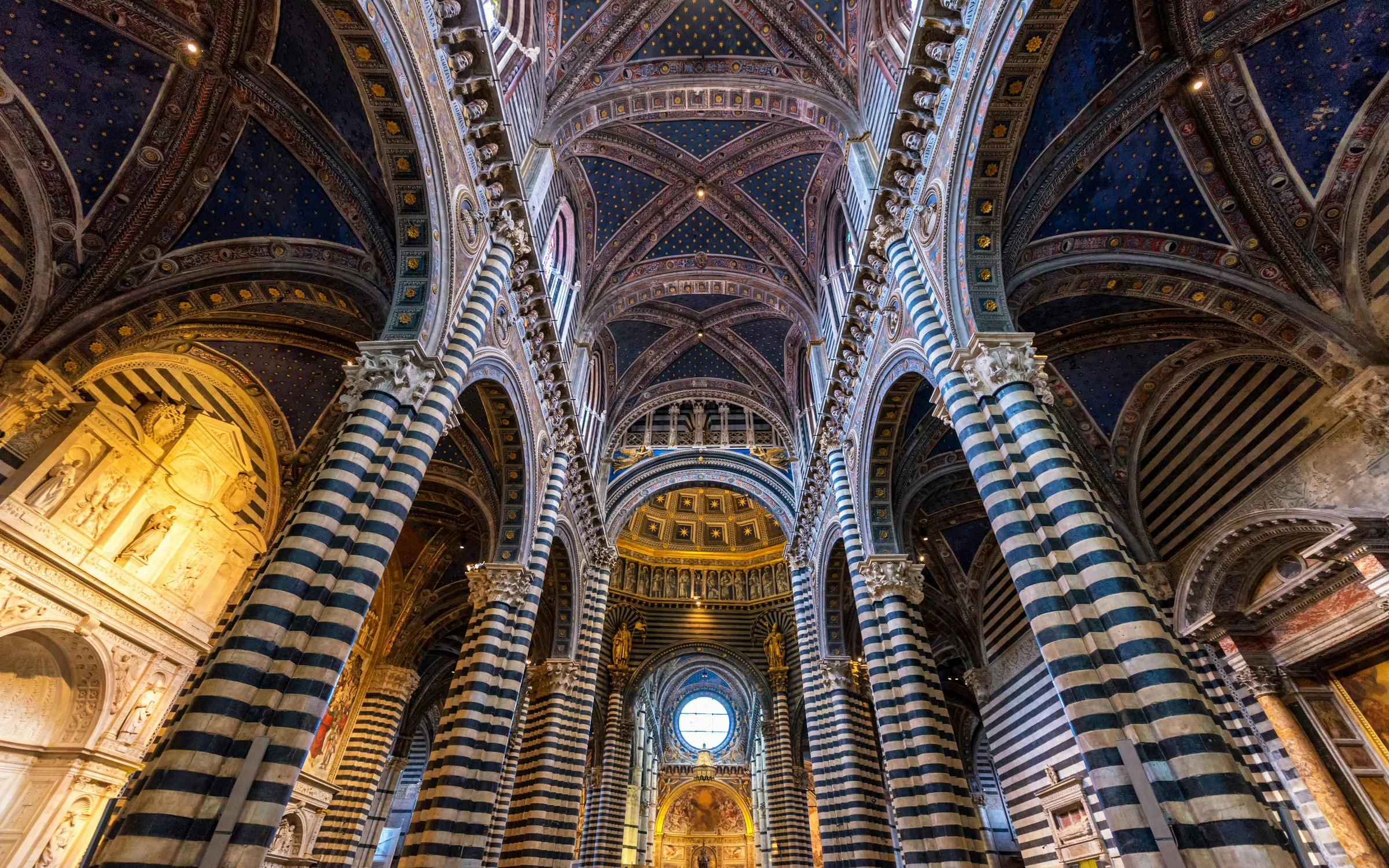
Siena Cathedral is one of Italy’s great Gothic churches. Built mainly between the 12th and 14th centuries, it reflects Siena’s wealth, faith, and artistic ambition. Its striped marble façade, sculpted details, mosaic floor, and works by major Renaissance artists make it a central symbol of the city.
7
Stop 7
10min
Galluzza Arches, known locally in Italian as Archi della Galluzza, are a series of arches crossing Via della Galluzza in Siena. The steep alley is one of the city’s most picturesque medieval passages, linking old houses, narrow views, and layered street architecture. Its name is traditionally connected with the poultry market once held in this area.
8
Fontebranda
10min
Fontebranda Fountain, known locally in Italian as Fontebranda, is one of Siena’s oldest and most important medieval fountains. Built in the 13th century near the city walls, it supplied water to residents, artisans, and animals through a complex Gothic structure. Its broad arches, brickwork, and connection with the wool industry reflect Siena’s engineering skill and everyday urban life.
9
Stop 9
10min
The Basilica of San Domenico is one of Siena’s major Gothic churches. Built mainly in brick between the 13th and 14th centuries, it is closely linked with Saint Catherine of Siena. Its austere architecture, chapels, relics, and hillside position reflect the city’s Dominican spirituality and medieval religious life.
10
Oratorio di Santa Caterina del Paradiso
10min
Oratorio di Santa Caterina is part of the sanctuary connected with Saint Catherine of Siena. Built after her canonisation in the 15th century, it stands near the area associated with her family home and her father’s dye workshop. The oratory reflects Siena’s devotion to its most famous saint, linking domestic memory, craft life, and religious identity.
11
Stop 11
10min
Statua di Sallustio Bandini stands in Piazza Salimbeni in Siena. Created by sculptor Tito Sarrocchi in the late 19th century, it honours the Sienese priest and economist associated with reformist ideas. The monument connects the square with civic memory, banking history, and Siena’s intellectual life.
12
Before you go
Ticket & redemption
Mobile or paper ticket accepted
One ticket covers the whole booking
Accessibility
Suitable for all physical fitness levels
Good to know
Public transportation options are available nearby
The audio guide is available through a special mobile app for iOS and Android
Admission tickets to the sights are not included. Please buy them separately in advance
The tour doesn’t cover all Siena sights
This is a self-guided tour. You will need to download the audio guide mobile app, activate your purchase, and follow the route on the app's map. There is no human guide provided
The audio guide is available anytime; the date and time provided for checkout are approximate
Location
Palazzo Tolomei
10min
Palazzo Tolomei is one of the oldest surviving private palaces in Siena. Built for the powerful Tolomei banking family, it dominates the square that still carries their name. Its severe Gothic façade, stone portals, and family associations reflect the wealth, rivalries, and urban authority of medieval Siena.
13
Stop 13
10min
Insigne Collegiata di Santa Maria in Provenzano is one of Siena’s most important churches after the cathedral. Completed and opened for worship in 1611, it became a major Marian sanctuary and is closely linked with the Palio of 2 July. Its Baroque architecture, sacred image of the Madonna di Provenzano, and Contrada traditions reflect Siena’s deep civic and religious identity.
14
Basilica di San Francesco
10min
Basilica di San Francesco is one of Siena’s major Gothic churches. Built for the Franciscan order, it is closely linked with the city’s religious life and the Eucharistic miracle of 1730. Its broad brick interior, artworks, chapels, and devotional history reflect Siena’s medieval faith, Franciscan presence, and civic memory.
15
Donna Alla Finestra
10min
Donna alla Finestra is a small sculpture in Siena’s Bruco district. Created in 1995 by Pier Luigi Olla, it shows a woman looking from a window, with a pomegranate and the tiny symbol of the contrada. The work reflects Siena’s playful street details, Palio identity, and the intimate character of its medieval lanes.
16
Porta Ovile
10min
Porta Ovile is one of the historic gates in Siena’s medieval walls. Built to control access to the northeastern side of the city, it connected Siena with roads, mills, fields, and water sources outside the walls. Its brick structure and defensive setting reflect the city’s fortified character and the practical life of medieval Siena.
17
Stop 17
10min
Fontanino della Contrada della Lupa is the ritual fountain of Siena’s She-Wolf contrada. Created in the 1960s by architect Giovanni Barsacchi, with a bronze she-wolf by Emilio Montagnani, it reflects the Palio tradition of contrada baptism, local identity, and the Roman legend at the heart of Siena’s symbolism.
18
Fortezza Medicea
10min
Fortezza Medicea is a large brick fortress on the edge of Siena’s historic centre. Built in the 16th century under Medici rule after the fall of the Sienese Republic, it reflects a period of political control and military power. Its bastions, walls, and elevated position connect Siena’s medieval independence with its later Tuscan history.